
Food Processing and Cold Storage Roofing for Akron commercial properties
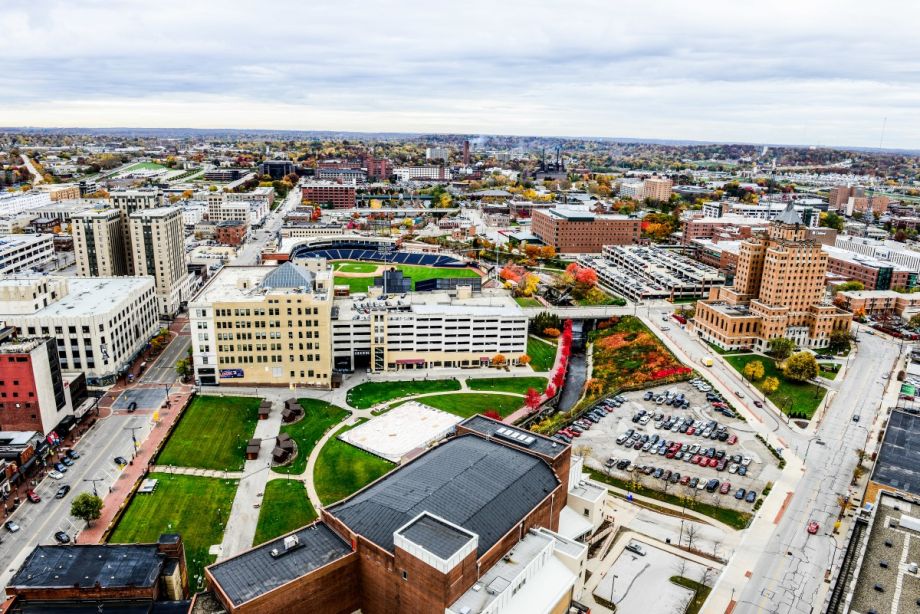
Akron sits at the intersection of Ohio's agricultural heartland and its industrial distribution network, making Summit County a natural anchor for food processing and cold chain logistics in the Great Lakes region. The city's position along I-76, I-77, and the Ohio Turnpike (I-80) puts it within overnight truck range of roughly 60 percent of the U.S. population — a geographic fact that has drawn cold storage and food distribution investment to the area for decades. Major food distribution operations anchored in the Akron-Canton corridor include regional grocery and foodservice warehousing, and the industrial parks along I-77 south of the city center host a mix of protein processing, snack food manufacturing, and produce distribution that keeps demand for specialized cold storage roofing consistently active.
HACCP compliance doesn't stop at the production floor. Food safety programs that govern processing and storage facilities require that any maintenance or construction work overhead in a production area be managed to eliminate contamination risk. For roofing contractors, this means formal contained-work protocols: physical barriers below the work zone, debris collection systems, no open-top chemical containers on roof decks above active production areas, and in some facilities, written approval from the quality assurance team before any penetration work begins during production hours. Akron's food manufacturers have become more rigorous about enforcing these requirements as retail customers and USDA auditors increasingly inspect maintenance records during certification reviews.
Cold storage roofing in Akron is governed by vapor physics that most commercial roofers don't encounter on standard builds. When a building is held at 28°F to 34°F for fresh produce or 0°F to -10°F for frozen storage, the vapor pressure differential between the interior and the exterior air wants to push moisture into the building envelope from the outside in summer, and from the heated perimeter spaces inward during winter. If insulation continuity is broken — by a fastener that bridges the thermal plane, by a compressed insulation section at a drain, or by a poorly detailed parapet cap — moisture migrates into the insulation layer and degrades R-value over time. A roof system that tested at R-32 at installation can fall below R-20 within five years if vapor barrier placement and insulation joint sealing aren't executed correctly.
High-pressure wash-down in Akron food facilities creates a distinct roofing consideration at drain lines and wall-floor junctions. Processing floors are washed down one to four times daily in high-throughput operations, and the combination of hot water, sanitation chemicals, and volume creates condensation and humidity spikes that work their way into wall assemblies. Where the exterior wall meets the roof plane — typically at the parapet base — water infiltration from interior wash-down humidity is a recurring failure vector. Correct detailing requires a continuous vapor retarder tied from the wall assembly into the roof membrane, not just a lap at the base flashing.
The Akron area's food industry includes anchor operations at the Midwest Food Bank distribution hub, grocery distribution centers supporting the regional Heinen's and Giant Eagle supply chains, and a cluster of snack and confectionery manufacturers in the Barberton and Cuyahoga Falls industrial zones. Several of these facilities operate under SQF (Safe Quality Food) or BRC Global Standard certifications, which include roof maintenance provisions as part of their food safety plans — specifically, documented evidence that roofing materials used in or above production areas are food-grade or non-contaminating.
Akron's weather directly affects cold storage roof performance in ways that owners sometimes attribute to equipment problems rather than building envelope failures. Lake-effect snow loading in Summit County can accumulate faster than rooftop drainage systems are sized to handle, and if a cold storage roof is held at or below freezing during a heavy snow event, the snow pack doesn't melt from below the way it would on a heated building. This means structural load calculations for cold storage in the Akron area need to incorporate full ground snow load rather than reduced values that assume some melt-off, and drainage systems need to handle burst-drain scenarios from rapid spring melt.
Insulation specification for Akron cold storage roofs typically calls for polyisocyanurate at the base layer for high R-value per inch, capped with extruded polystyrene (XPS) at the top layer where moisture resistance near the exterior surface is more critical than raw R-value. The total assembly commonly targets R-30 to R-40 depending on the storage temperature and the facility's energy cost baseline. Some Akron operators have moved to vacuum-insulated panel systems in recent renovation projects, which achieve R-50 or higher in a thinner assembly but require specialized installation and careful coordination with roofing membrane work to avoid panel damage.
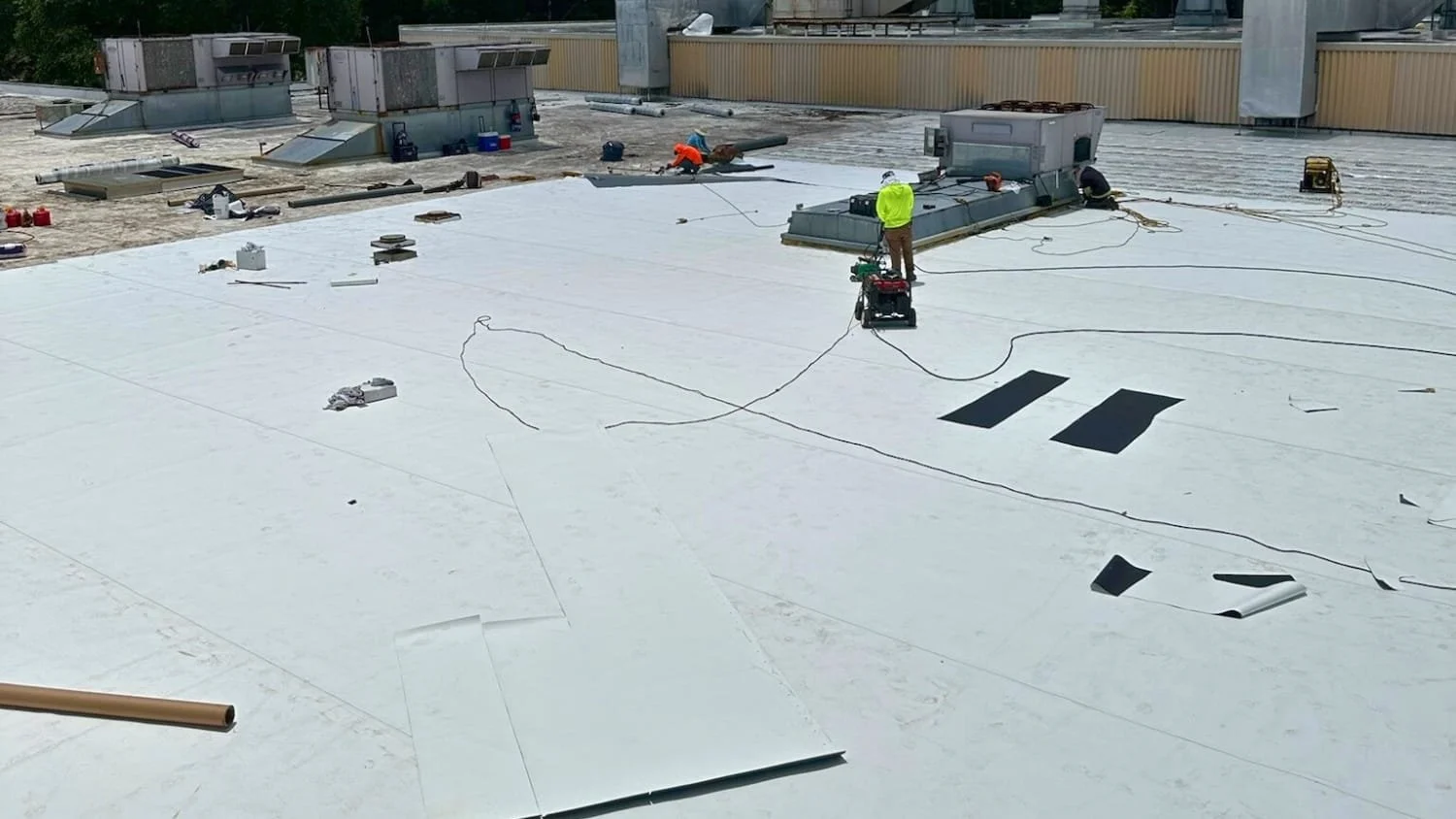
Reroofing active food facilities in Akron requires a phased approach that's more complex than standard commercial re-roofing. Work typically proceeds in sections with full containment of the active section before any tear-off begins. All removed insulation and membrane are bagged and removed from the roof deck in the same shift rather than staged overnight. Material deliveries are coordinated to avoid staging on roof sections directly above active production lines. On facilities with ammonia refrigeration systems, roofing crews must be briefed on emergency evacuation procedures before work begins — a requirement that some contractors overlook until the first safety audit.
Long-term performance on Akron food facility roofs correlates most strongly with drain maintenance discipline and parapet cap flashing integrity. Drains in cold storage environments accumulate frost and condensate residue that can partially block drainage even when the roof surface is otherwise clean. Semi-annual drain inspections — more frequent on below-freezing storage buildings — and parapet cap inspections after each winter season are the two maintenance actions that consistently prevent the majority of reported leaks on well-installed systems.
Questions Owners Ask
How do we prevent contamination when roofing over an active processing line?
The standard protocol for Akron food facilities requires a physical debris barrier below the entire work zone — typically a 6-mil poly drop sheet system anchored to the underside of the roof deck or suspended from purlins. All removed materials are lowered in sealed containers, not dropped. No liquid chemicals are opened on the roof above active production. Most SQF and USDA-inspected facilities also require the roofing contractor to sign a visitor acknowledgment form confirming awareness of contamination control procedures before work begins.
What's the right R-value for a -10°F freezer roof in Akron's climate?
For a -10°F frozen storage facility in Summit County, the target roof assembly R-value is typically R-35 to R-40, accounting for Akron's heating degree days (roughly 6,000 HDD annually) and the operational energy cost at current natural gas and electric rates. A two-layer system using 4-inch polyiso at the base and 2-inch XPS at the top achieves approximately R-32 to R-36 after long-term thermal resistance degradation is factored in. Some operators in the market add a third layer to hit R-40, which is justified for facilities running 24/7 on electric refrigeration.
How do we document roofing work for our SQF or BRC audit?
Auditors reviewing roofing maintenance under SQF or BRC typically want to see: a written scope of work documenting all materials used and their food-contact safety status, a contractor acknowledgment of facility HACCP procedures, before-and-after inspection photos, and a sign-off from the QA manager that contamination control procedures were followed throughout the project. We provide a project completion packet that includes all of these elements as a standard deliverable on any food facility job in Akron.
We're seeing condensation on the underside of the roof deck — is that a roofing problem?
Underside condensation on a cold storage roof deck in Akron is almost always a vapor barrier placement problem, not a membrane leak. When the vapor retarder is installed on the wrong side of the insulation assembly — or is missing entirely — warm humid air from outside reaches the cold deck surface and condenses. The fix requires adding a properly positioned vapor barrier, typically above the structural deck and below the insulation, with all seams lapped and taped. In some cases, adding a vapor barrier without addressing insulation continuity gaps doesn't fully resolve the problem and a full system review is needed.
Can we re-roof the freezer section while the refrigeration system stays online?
Yes, this is standard practice in Akron cold storage re-roofing. The sequencing requires working in sections no larger than the refrigeration system can compensate for — typically 2,000 to 4,000 square feet per active section depending on system capacity. During the active section, a temporary vapor and weather barrier is installed before any insulation is removed to limit the thermal load on the refrigeration system. The refrigeration team should be looped into the phasing schedule so they can monitor and adjust suction pressure during the work to prevent product temperature excursions.