

Multi-Tenant Retail Strip Roofing for Akron commercial properties
On a retail strip, a leak that looks like one tenant's problem has usually crossed wet insulation into two or three storefronts before anyone reports it. From inside a single unit the source can seem obvious, but the actual failure is often a shared drainage line, a seam over the demising wall, or edge metal upstream. We follow the roof evidence so an owner is not patching over one ceiling tile while the real defect keeps feeding several bays.
The owner on a retail strip is usually an operator trying to address the roof without disrupting the tenants and their customers below. A center near the Akron-Canton Airport may only allow short weather windows, while a strip along US-224 might be governed by parking-lot deliveries, tenant hours, and steady retail traffic. We write the scope around keeping storefronts open and drier while the work happens overhead.
The Akron-Canton normals from 1991-2020 record about 41.57 inches of yearly precipitation and roughly 47.2 inches of snow, and on a shared-roof strip that water finds the weakest bay first. Drainage across multiple units, refreeze at common drains, and wet insulation over occupied stores all stay front and center. With May near 4.17 inches of rain around Firestone Park, we size open work so no storefront is left exposed when a spring storm moves through.
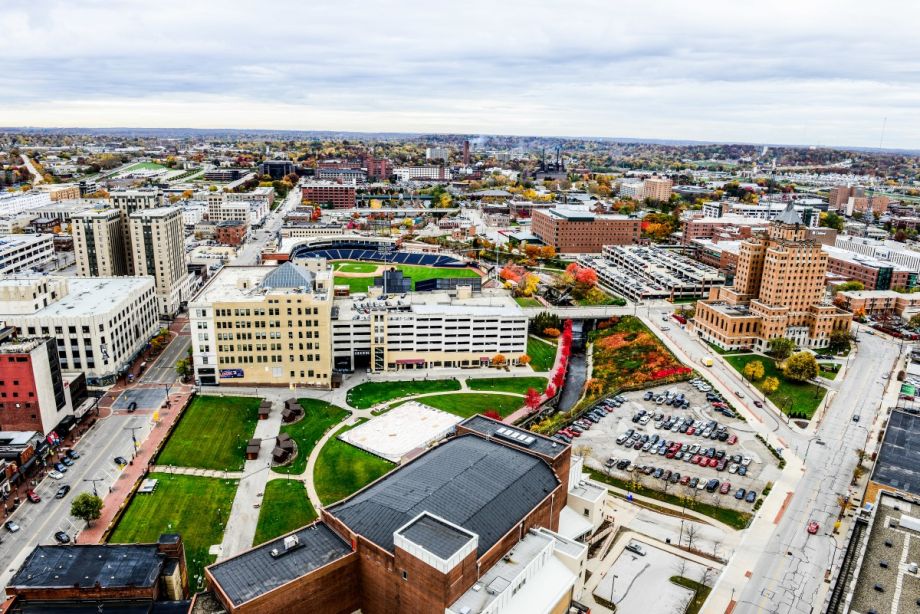
Retail strips do not sit in one Akron building pattern. A center Downtown near Cascade Plaza raises different questions than one near Lock 3, the University of Akron, Summa Health, or the Akron-Canton Airport area, where access and traffic reshape the plan. Along Arlington Road a roof can move from tight retail constraints to open service deck within a short drive, so we plan the strip scope to the specific corridor rather than a generic box.
A retail strip is one roof serving many businesses, and the tenants underneath rarely share a schedule or a lease term. A leak over a single storefront is that operator's emergency, even when the rest of the center is dry. Multi-Tenant Retail Strip Roofing has to keep each demised space protected and each lease boundary clear, which shapes the work more than the membrane spec on any Akron-area center.
Retail strips often sit along I-76, I-77, SR-8, I-277, and US-224, with Arlington Road and West Market Street feeding the parking lots. Around Wadsworth that means the roof scope has to anticipate delivery and customer traffic below, membrane staging clear of storefronts, rooftop HVAC per tenant, future fit-outs as units turn over, snow-removal paths, and delivery routes that keep material off the sales floor frontage.
A retail strip is worked by roof area with the record kept tenant by tenant, so every bay is matched to the storefront under it. The walk logs membrane type and age, per-unit rooftop equipment, ponding lines, drain strainers, edge-metal condition, wall and demising transitions, and pitch pockets, plus any grease exposure from food tenants. Tenant leak reports, snow-drift patterns, and interior ceiling evidence are noted unit by unit. Should a moisture scan or core cut near Macedonia change the story, the recommendation moves with it.
On a multi-tenant strip, tenant impact frames whether you patch, recover, coat, or replace, and each of those is its own decision. A dry deck with one failed seam over a common area usually stabilizes with a targeted repair. But wet insulation, a soft deck, water standing at the drains, or edge metal working loose above occupied stores calls for a wider budget talk first, before a quick patch hides the real condition and a chargeback lands on the wrong tenant.
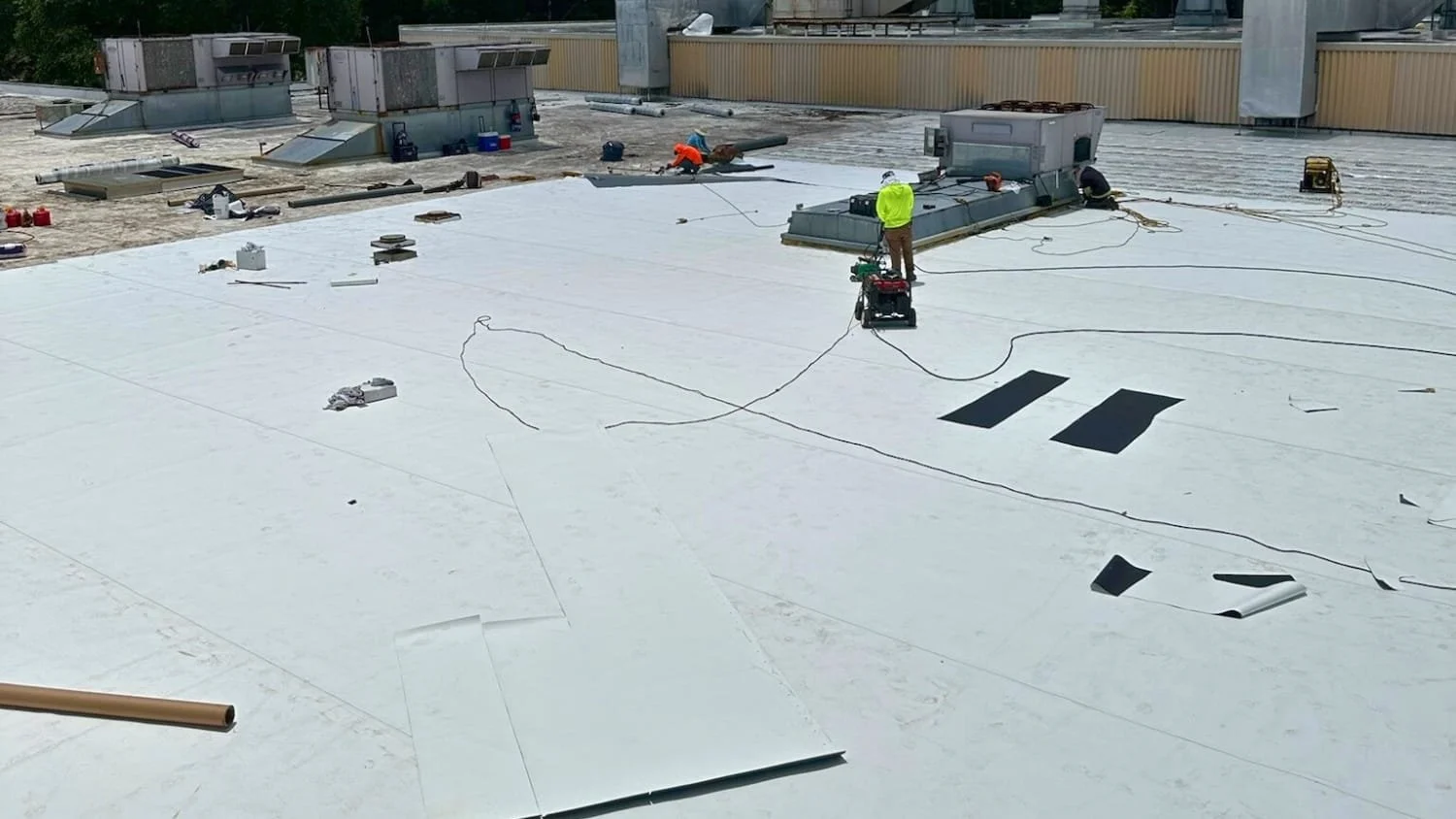
Cost on retail strip work comes down to practical drivers: roof access over an active lot, fall protection, tear-off volume, wet and tapered insulation, drain work, coping, wall flashing, temporary protection, after-hours labor around store hours, wind exposure, snow handling, and staging around occupied storefronts. We flag each in the estimate so ownership can see why a section over a busy food tenant with grease exposure prices higher than an easier, vacant bay.
Documentation matters once retail strip roofing touches insurance, tenant relations, or capital planning. We provide roof-area notes, photo locations, repair limits, known exclusions, access constraints, and the weather-sensitive details behind each call. On claim-related work we record contractor observations without acting as a public adjuster or promising an insurance outcome.
The center stays protected through open roof work by keeping the schedule tight. Material stays clear of the drains, open sections are sized to the forecast, and close-in decisions are settled before the next round of rain, wind, or heavy melt. Around the Main-Market Historic District that matters, since a small opening above an occupied storefront can become an interior loss before the next dry window.
We are ready to move on a retail strip when the owner needs a firm repair number, a maintenance plan, or a capital budget for the center across Akron, Summit County, Cuyahoga Falls, Barberton, Fairlawn, Green, Stow, Hudson, Kent, Wadsworth, and the Akron-Canton corridor. What we deliver is a roof-specific scope, not a generic recommendation.
Our extra pass on retail strip roofing pulls in old patch records, roof-traffic patterns, maintenance logs, warranty paperwork, prior interior leak history per unit, drain paths, freeze-thaw exposure, and the access notes that move the cost. That record gives the owner a real roof decision on the center, not a square-foot quote with the important assumptions left out.
Questions Owners Ask
What changes the realistic cost for Multi-Tenant Retail Strip Roofing?
Rooftop access over open storefronts, wet insulation, deck repair, edge metal, and drain work move the cost of Multi-Tenant Retail Strip Roofing well before the roof label does. Restaurant exhaust curbs and clusters of small tenant HVAC units add their own scope. We verify those items on the center before treating any unit price as firm.
Can Multi-Tenant Retail Strip Roofing be done while the building stays open?
Often, but several storefronts and leases have to be planned around. We review tenant entrances, rear delivery doors, roof access over occupied suites, noise, odor, weather windows, and safety zones before recommending daytime, phased, or off-hours work.
How do we decide between repair, recover, coating, and replacement for Multi-Tenant Retail Strip Roofing?
We look at moisture, deck condition, attachment, slope, seam condition, drain performance, winter exposure, and edge-metal risk across shared roof areas and demising walls between tenants. If the membrane over the storefronts is dry and stable, preservation may stay on the table. If moisture is spreading, replacement planning becomes more defensible.
What documentation is included after a Multi-Tenant Retail Strip Roofing inspection?
Documentation includes roof-area notes tied to individual suites, photo locations, leak observations near tenant spaces and rooftop units, priority levels, repair limits, access constraints, and budget categories. Storm work gets contractor-side evidence without promises about claim outcomes.
How quickly can you look at Multi-Tenant Retail Strip Roofing after a winter storm or hail event?
Timing on a strip-center roof depends on access, weather, crew load, and whether water is reaching an occupied storefront. We triage active leaks over open tenants first, then separate a temporary dry-in from the permanent repair staged around business hours.