
Storm Damage Roof Repair in Akron, OH for Akron commercial properties
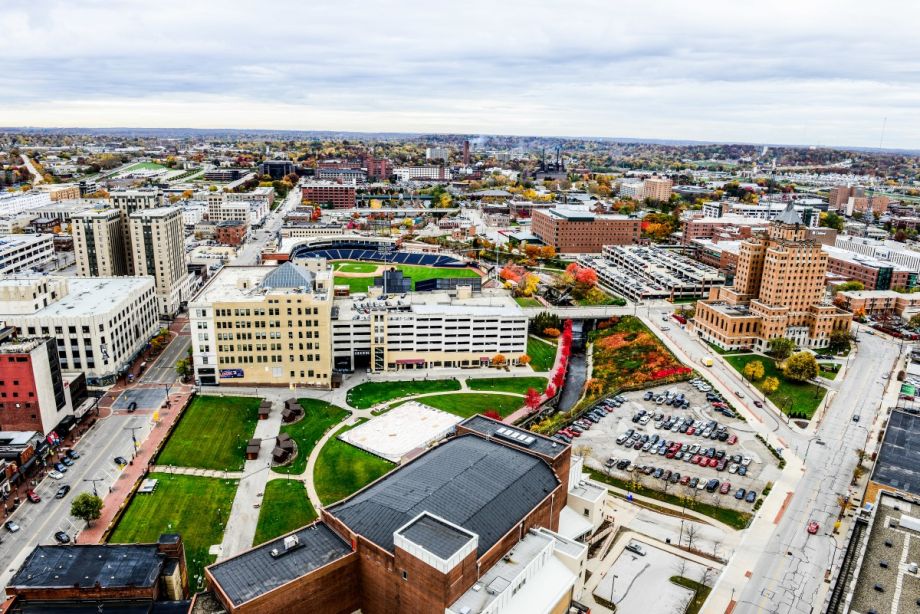
Akron's commercial base spans the Innerbelt corridor, downtown's Bowery redevelopment district, and the Summit County industrial parks along I-77 and State Route 8. Storm damage documentation and insurance claim roofing in this market requires a contractor who can produce GPS-tagged hail impact maps, wind damage assessments, and supplemental claim documentation in the format that commercial property adjusters use — not just a repair estimate, but the evidence package that documents the claim at full scope.
Northeast Ohio's severe thunderstorm season has a specific geographic character that differentiates it from storm damage in other Ohio markets. The Akron metro sits at the convergence zone where Gulf of Mexico moisture, Canadian cold air outflows, and Lake Erie fetch combine to produce convective systems that are more frequent, more intense, and more capable of generating both large hail and destructive straight-line winds than areas to the south and west. The National Weather Service storm data for Summit County records an average of 8 to 12 severe thunderstorm events per year — events meeting the NWS threshold of 58 mph winds or 1-inch hail — with peak activity in May and June. These events do not strike uniformly across the region; individual storm cells can affect a 5-mile corridor while buildings a mile away experience nothing. If your commercial building was in the path of a documented severe storm, it warrants a professional roof inspection regardless of whether interior damage has appeared yet.
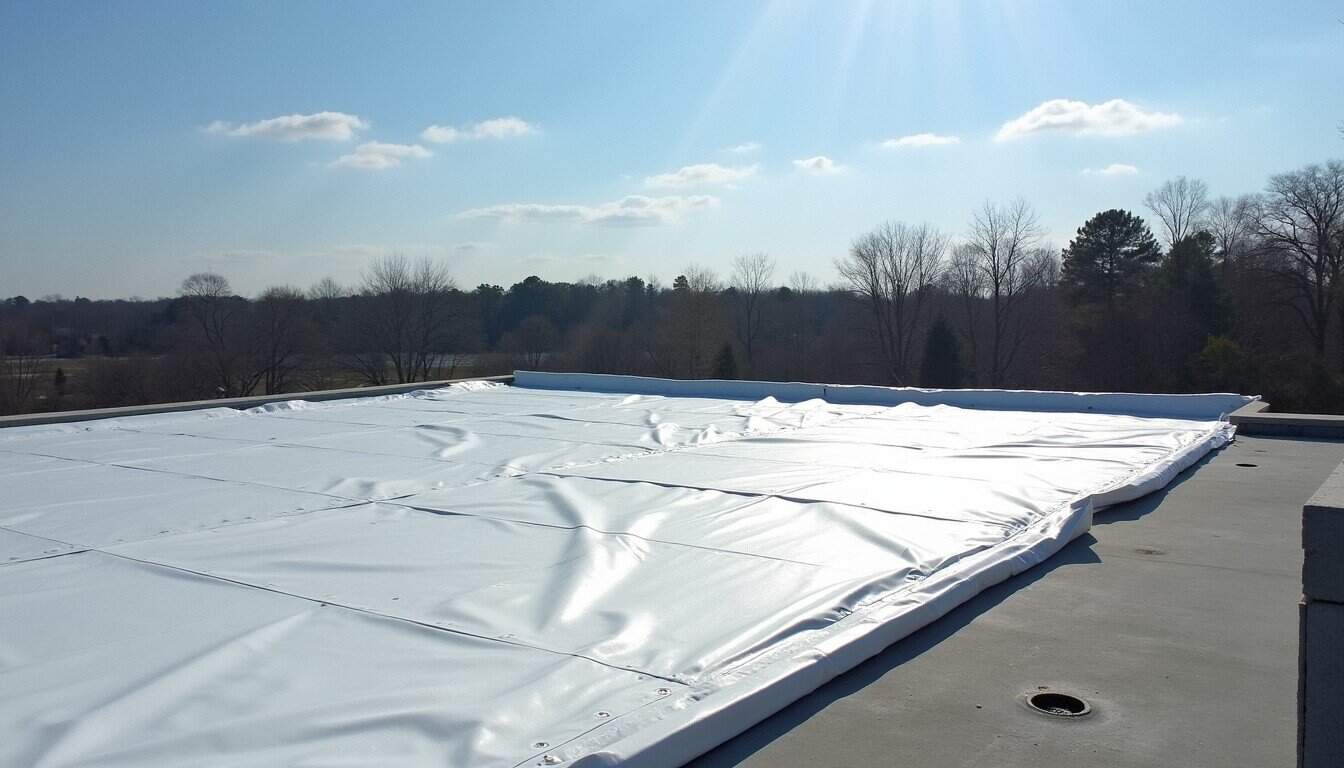
Straight-line wind damage to commercial roofing systems in Akron produces characteristic failure patterns that differ from hail and from tornado damage. Sustained 60–80 mph straight-line wind events — capable of being generated by bow-echo thunderstorm systems that sweep across Summit County several times per season — apply upward pressure (uplift) to commercial roof assemblies at corners, edges, and perimeter zones where the aerodynamic geometry creates negative pressure pockets. Single-ply membranes that are insufficiently attached at the perimeter — particularly those with mechanical attachment that did not meet current FM or ASCE 7 wind uplift requirements — can be progressively peeled from the field area outward from the perimeter during sustained high-wind conditions. The failure is rapid; a membrane that was sound before a 70 mph event may have 2,000 square feet of billowing, partially detached field membrane within 20 minutes of the wind onset.
Derecho events — fast-moving straight-line windstorms that can sustain 70–100 mph winds over broad geographic areas — have impacted the Akron metro multiple times in the past decade, most notably in the 2012 and subsequent events that caused widespread commercial property damage across northeast Ohio. A derecho event differs from a standard severe thunderstorm in its geographic extent (hundreds of miles rather than a local cell) and its duration at any given location (sustained high winds for 20–40 minutes rather than brief peak gusts). This sustained duration is what separates derecho wind damage from ordinary severe storm damage: every vulnerable roofing condition has extended time to fail rather than a brief peak load. Post-derecho damage assessments in Summit County consistently reveal perimeter flashing failures, parapet coping displacement, and membrane peeling on buildings that had survived individual severe storms without incident.
Akron Children's Hospital and Summa Health are the highest-consequence storm damage response scenarios in Summit County's commercial roofing market. Both healthcare systems operate critical care areas — emergency departments, surgical suites, ICUs — where a storm-caused roof breach cannot be managed by moving people or operations the way a warehouse or office building can. Active patient care areas with water intrusion from a storm event represent an immediate infection control concern and a patient safety risk that triggers incident reporting, facility security protocols, and regulatory notification in some cases. Our relationship with both healthcare campuses includes a pre-authorized emergency response protocol that bypasses the normal contractor qualification process so that response can begin immediately when a storm-related call comes in. This is not a capability built during an emergency — it requires a relationship established before the storm.
Hail documentation in the immediate aftermath of a storm event is time-sensitive in a way that building owners sometimes underestimate. The evidence of hail size — the circular dent pattern and diameter of impacts on soft metal surfaces like HVAC condenser fins, gutters, and sheet metal trim — fades as those surfaces weather and are cleaned during routine maintenance activities. A post-storm inspection conducted within 48–72 hours captures the clearest physical evidence of hail caliber. Membrane impact marks are also clearest in the immediate post-storm window before UV weathering begins to obscure the freshness of the impact. We prioritize post-storm commercial inspections as emergency dispatches when building owners call within days of a significant event, and we maintain weather data documentation that records the specific meteorological parameters of storm events in Summit County for claim support purposes.
Wind-driven rain penetration — where 50+ mph winds force rain horizontally through gaps that normally drain by gravity without leaking — is a storm damage mode that confuses building owners because the leak appears in unexpected locations. Vertical surfaces — parapet walls, HVAC curb sides, mechanical equipment housings — can be penetrated by wind-driven rain at pressure levels that far exceed what gravity-drainage conditions create. A parapet base flashing that is marginally adhesed but hasn't leaked in years can fail under wind-driven rain because the driving pressure exceeds the adhesive bond strength at the unsealed lap edge. After a storm with reported winds above 50 mph, perimeter flashings and parapet conditions should receive specific inspection attention beyond the standard field membrane review.
Large-format retail and commercial buildings on the Fairlawn-Bath corridor — big box retail, strip centers, and power center anchors — have rooftop profiles that are particularly vulnerable to wind uplift: large, flat, low-slope roofs with long uninterrupted spans, moderate parapet height, and perimeter edge metal that may have been installed to standards below current FM uplift ratings. Post-storm damage to these buildings follows a predictable pattern: edge metal lifts at corners, membrane billows at the perimeter above the edge metal, and if the wind event sustains long enough, the peeling progresses toward the center of the field area. We conduct post-storm assessments on retail corridor buildings rapidly after events because the extent of wind damage to a large-format roof can still be actively increasing in the hours after the storm if the temporary attachment of partially lifted membrane sections is at its limit.
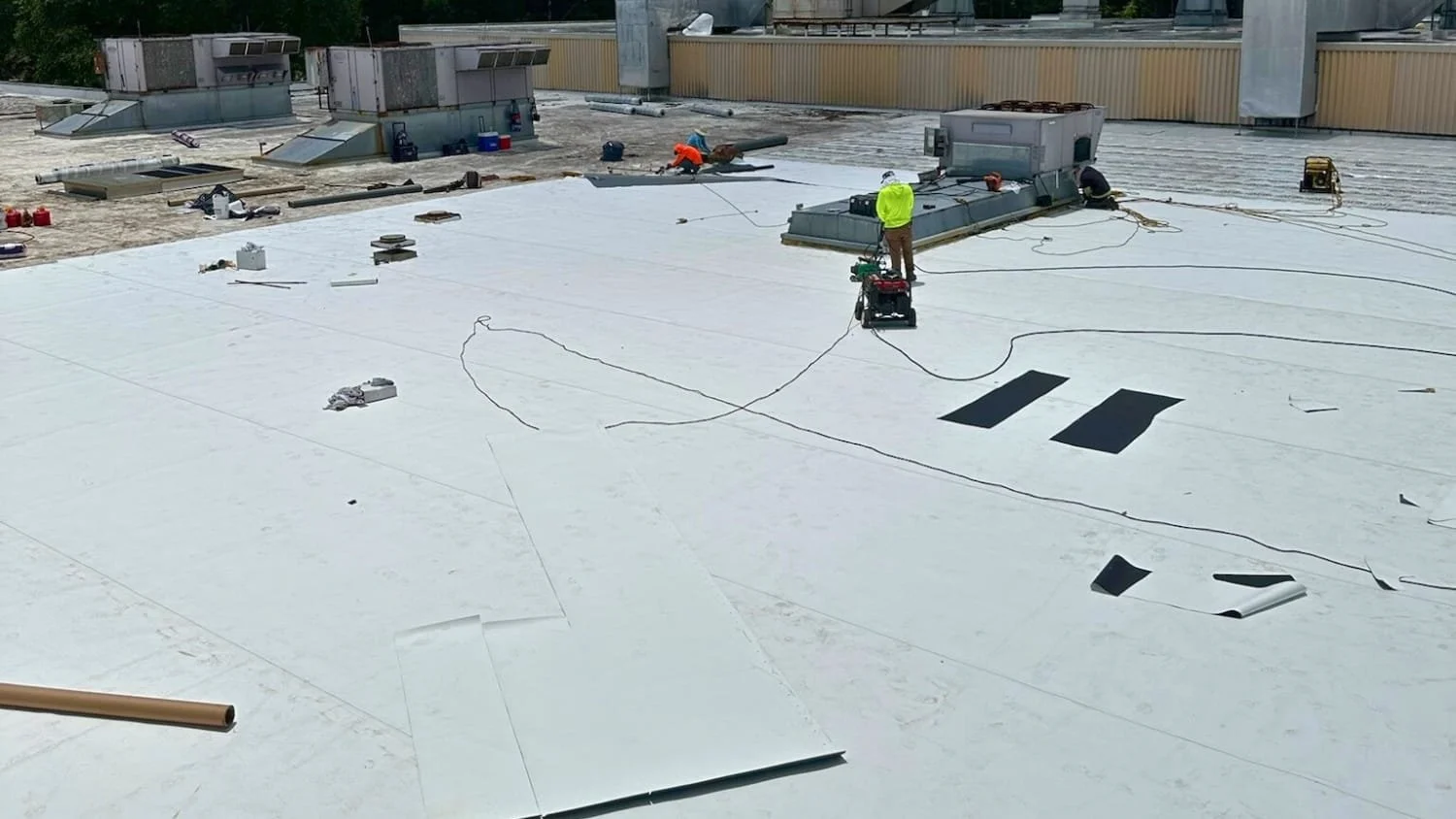
Repair execution for storm damage follows the same principles as any commercial roof repair but with the documentation discipline that insurance claim support requires integrated into the process from the first site visit. Every repair scope developed for storm damage is documented with pre-repair photographs, measurements, and cause analysis before any work begins. Temporary closure is applied where permanent repair cannot be immediately executed, with the temporary scope documented separately from the permanent repair scope. Permanent repairs are executed to restore the system to pre-storm condition and, where the storm has revealed underlying conditions that warranted remediation, to a condition that meets current installation standards. We provide documentation of the difference between storm-caused damage and pre-existing conditions, which is the foundation of a successful and complete insurance claim.
Questions Owners Ask
How quickly should I have my roof inspected after a severe storm in Akron?
Within 48–72 hours is the ideal window for maximizing hail evidence quality and documenting conditions before secondary weathering obscures the storm-specific damage pattern. Practically, if no interior damage is apparent, within two weeks is adequate for most storm events. Any building with active interior water intrusion following a storm should call for emergency response on the day of or day after the event — waiting allows water damage to accumulate in insulation, ceiling, and interior finishes, increasing the total loss. We treat post-storm calls with active interior damage as emergency dispatches.
What's the difference between hail damage and wind damage from a storm?
Hail damage manifests primarily as impact marks in the field membrane — circular dimples, punctures, or bruise patterns across the roof surface, combined with dents on soft metal HVAC equipment and edges. Wind damage manifests primarily at the perimeter and edge conditions — lifted edge metal, peeled membrane from corners and perimeter zones outward, displaced parapet coping, or failed fasteners at mechanical attachment rows. A severe storm event often produces both; post-storm inspection documents both mechanisms separately because they may have different claim treatments and different repair scopes.
My building was in the path of a documented storm, but I don't see any interior damage. Should I still have an inspection?
Yes — particularly for hail events. Functional hail damage (membrane punctures that allow moisture to enter the insulation) does not always produce immediate interior drip evidence. The moisture may infiltrate insulation for weeks or months before it migrates to the interior ceiling. Documented presence of a storm event in your building's location is sufficient reason for a professional inspection regardless of interior damage status. The inspection may confirm no damage and costs nothing but your time. If it reveals damage, the early documentation protects your insurance claim and prevents further moisture accumulation in the assembly.
What is wind uplift and why does it matter for my commercial building?
Wind uplift is the upward force created when wind flows over a flat or low-slope commercial roof at high velocity, creating negative pressure (suction) above the roof surface. The uplift force is greatest at corners and perimeters — areas with the most aerodynamic pressure differential. Commercial roofing systems are designed to resist specific uplift loads based on the building's location, height, and exposure category, as defined in ASCE 7. Systems not meeting the required uplift resistance for their specific installation are vulnerable to peeling during high-wind events. FM Global approval ratings for roofing assemblies directly correspond to tested uplift resistance values, and we specify FM-approved assemblies on all new commercial installations in Summit County.
My neighbor's tree fell on my commercial roof. Is that a storm damage claim?
Yes — tree impact on a commercial roof from a storm-felled tree is typically covered as a sudden and accidental loss under a commercial property policy. The claim covers roof damage at the impact location and any secondary water intrusion damage that resulted from the breach. Documentation requirements are the same as for other storm claims: inspection report with photographs, impact location measurements, and repair scope with cost estimate. We respond to tree impact situations as emergency calls and provide the documentation needed for an insurance claim submission on the initial visit.