Insulation and Recovery Board in Akron, OH for Akron commercial properties
In Akron's commercial roofing market, the insulation decision is the most consequential financial choice in any reroofing project — more expensive to get wrong than any membrane selection, and more directly tied to building energy performance than any surface treatment. The fundamental question in Summit County's 47.2-inch-annual-snowfall climate is always the same: is the existing insulation dry? The answer to that question determines whether a recover — adding a new membrane over the existing assembly — is a sound investment or a deferred disaster. Wet insulation beneath a new membrane cannot dry out. It will continue to degrade, reduce R-value, corrode metal decks, and eventually create the same moisture problems that prompted the reroofing project in the first place, typically within five to ten years.
Infrared moisture scanning before any recover decision is not a premium add-on service in the Akron market — it is the baseline standard for responsible commercial roofing practice. Wet insulation retains solar heat longer than dry insulation, creating detectable thermal anomalies that show clearly on a calibrated thermal camera scan conducted after dark following a warm sunny day. The scan provides a plan-view map of moisture distribution across the roof, which drives the core sampling program: physical cores are taken at anomalous locations to confirm thermal readings with physical evidence. The combination of infrared scan and core confirmation gives the building owner an accurate picture of insulation moisture content across the entire roof, not just the areas that are obviously failing.
The legacy industrial buildings in Goodyear Heights, along Kenmore Boulevard, and in Firestone Park present particularly complex insulation conditions. Many of these buildings were originally constructed with poured lightweight insulating concrete as both insulation and slope-to-drain material. This material — vermiculite or perlite aggregate with Portland cement — absorbs water readily and never fully dries once saturated. Buildings with this substrate that have experienced any membrane breach may have compromised insulating concrete across significant areas, even if the breach has been repaired and no new moisture is entering. When we core these buildings and find saturated insulating concrete, the recommendation is almost always full tear-off — there is no cost-effective way to dry this material in place, and recovering over it simply delays an inevitable replacement while continuing to pay the energy penalty of degraded R-value.
Polyisocyanurate (polyiso) board is the dominant insulation specification for new commercial roofing in Akron and the standard recovery board in most re-roofing applications. Polyiso provides the highest R-value per inch of any commercial roofing insulation — typically R-6 per inch — which is important in Summit County where Ohio Energy Code R-value requirements for Climate Zone 5 commercial roofing have increased in recent code cycles. The relevant caution for Akron's climate is that polyiso experiences R-value reduction at low temperatures — a phenomenon called thermal drift or R-value reduction at cold temperatures that affects the material's real-world winter performance. For buildings where winter energy performance is a priority, we layer polyiso with a coverboard of EPS or mineral wool that does not experience the same cold-temperature R-value reduction.
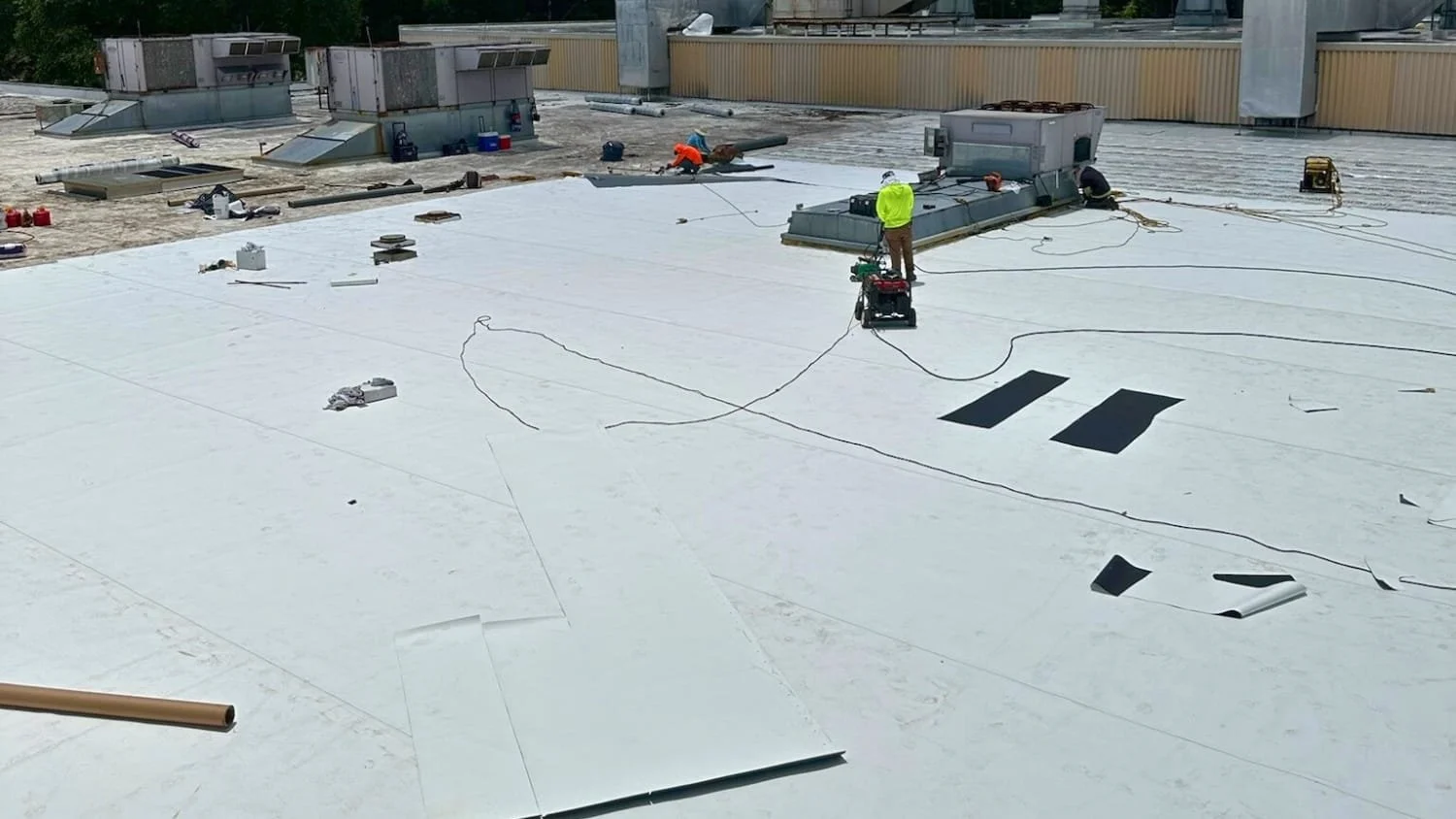
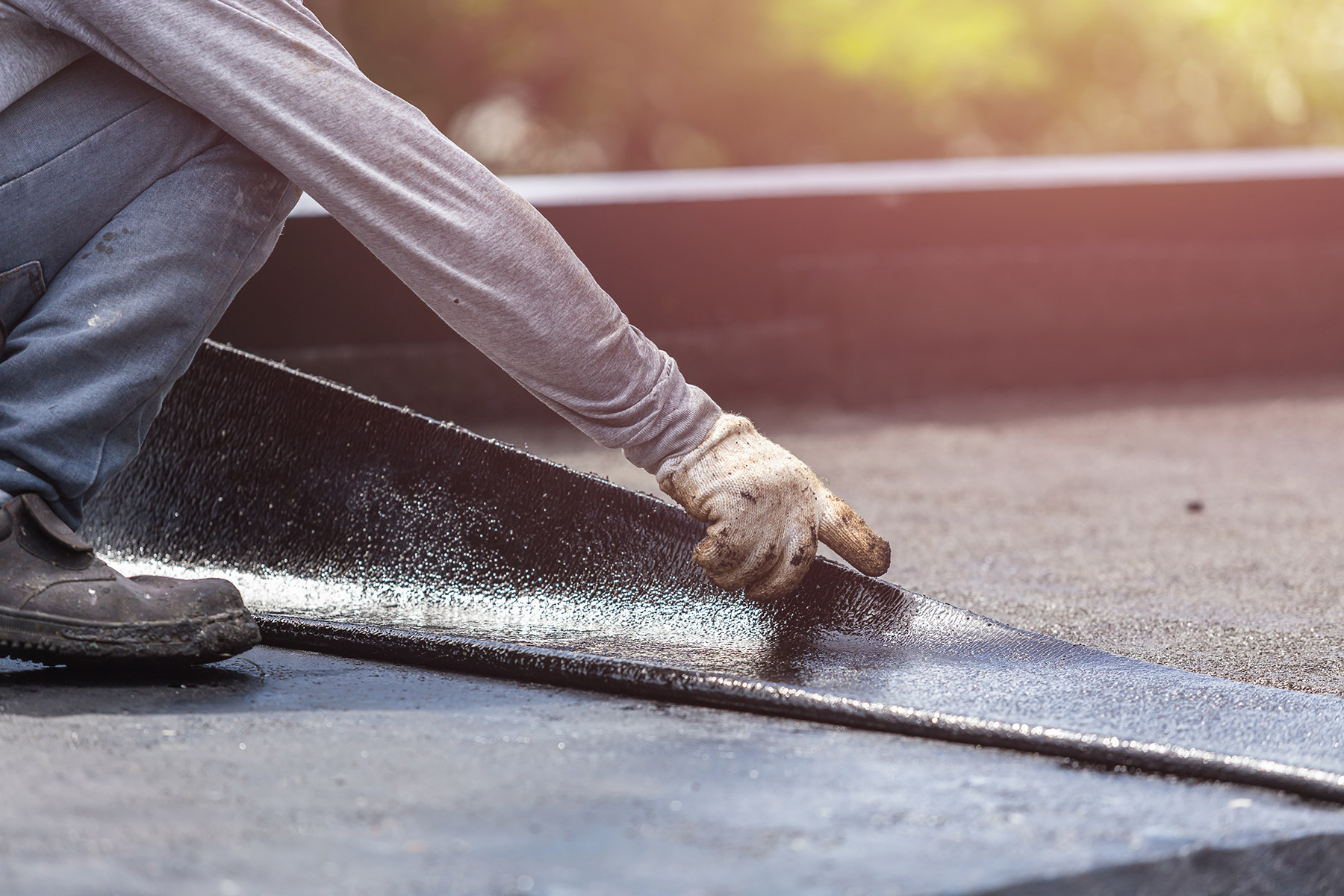
Recovery board — a thin rigid board layer applied over the existing insulation before the new membrane — serves multiple purposes in a recover application. It provides a smooth, uniform surface for membrane adhesion or mechanical attachment; it bridges minor surface irregularities in aged existing insulation; it adds modest additional R-value; and it creates a sacrificial layer that absorbs condensation cycling at the membrane/insulation interface. In Akron's climate, the insulation/coverboard interface is a potential moisture accumulation zone during the winter season, and specifying a coverboard with low moisture absorption and appropriate vapor retarder placement is part of a properly engineered recover assembly for northeast Ohio conditions.
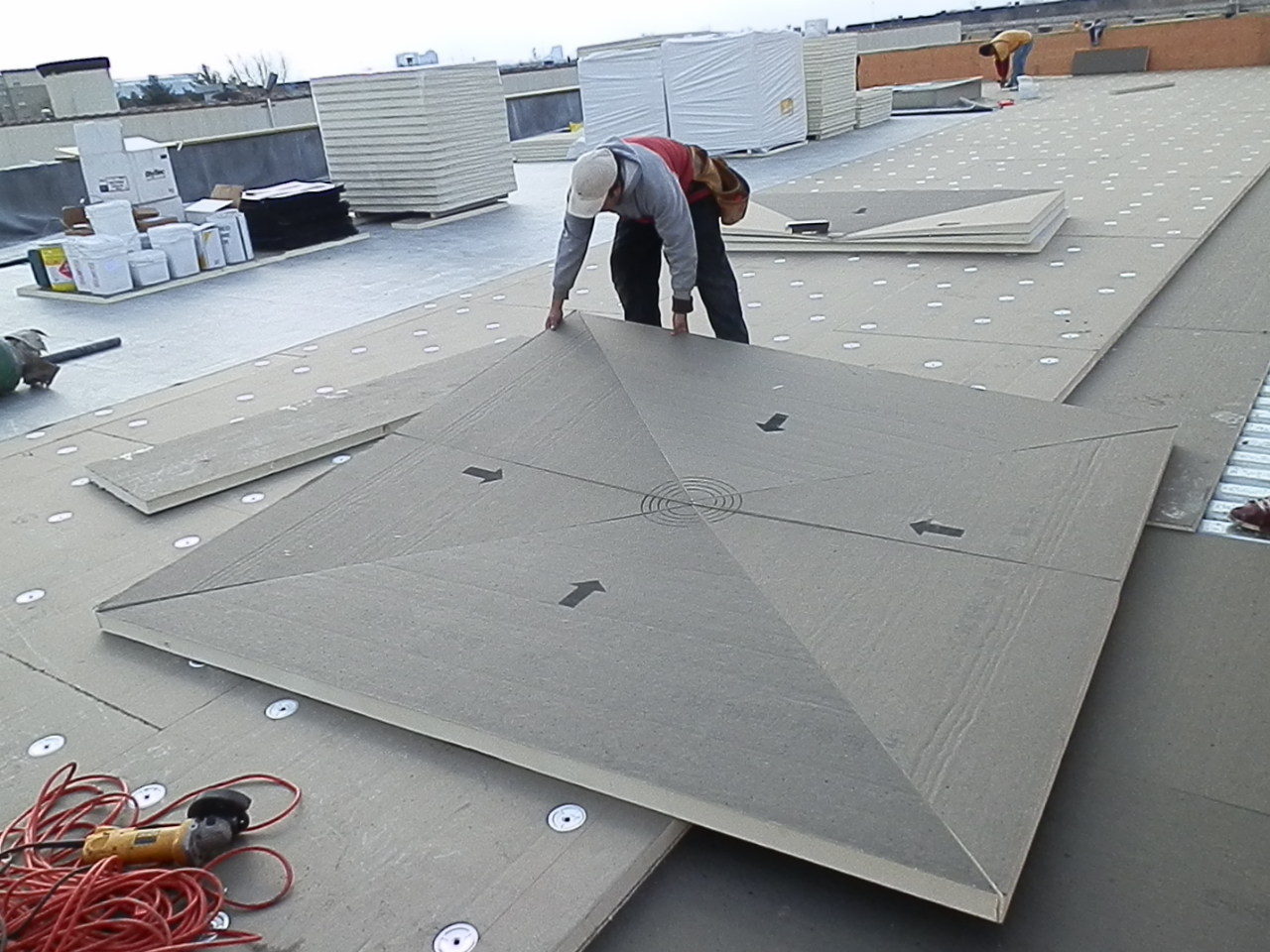
Tapered insulation systems are the appropriate specification for any commercial building in Akron with a flat deck and inadequate roof drainage slope. Buildings constructed in the 1960s and 1970s — well-represented in Akron's commercial stock in both the older neighborhoods and the first-generation suburban business parks — often have minimal designed slope, relying on drain placement alone to manage water. In Akron's snow climate, drains that freeze or clog remove the designed drainage pathway entirely, and any remaining free-standing water must drain by gravity across the field membrane. Tapered insulation installed to ¼-inch-per-foot toward drains creates positive drainage that functions even when drain flow rates are reduced by partial freeze-over or debris accumulation.
The IBC two-layer recover rule — requiring tear-off when adding a third membrane layer — is a practical constraint for Akron's older commercial building stock, many of which already carry two generations of roofing. Before recommending a recover, we confirm the number of existing layers and assess whether a third layer would trigger a code-required tear-off. In many cases, the building's structural loading capacity is also a factor: adding recover board and a new membrane to a building already carrying two membrane generations can push the total roof dead load close to the structural system's design capacity, particularly on older light-gauge steel framing. We conduct load calculations when the existing assembly indicates multiple prior roofing generations.
For the CAK airport-area commercial corridor and the Fairlawn office park inventory — primarily post-2000 construction on steel-deck substrates — the insulation decision is more straightforward: these buildings typically have a single generation of polyiso board in sound condition, and the recover question is primarily about confirming dry insulation and selecting the appropriate recover board thickness and specification. Our assessment for these buildings focuses on insulation R-value compliance with current code, moisture content at core sample locations, and fastener plate condition for mechanically attached systems.
Building owners investing in insulation as part of a reroofing project in Akron should understand the dual return: lower energy costs year-round (heating-season savings are significant in Summit County's climate) and reduced thermal cycling stress on the new membrane, which extends the service life of the entire assembly. The incremental cost of upgrading from minimum code R-value to an enhanced specification is modest relative to the total project cost and pays back within a reasonable time horizon when both energy savings and extended membrane life are included in the calculation.
Questions Owners Ask
How accurate is infrared scanning for detecting wet insulation?
Properly conducted infrared scanning — performed after dark following a sunny day, with a calibrated camera operated by a trained thermographer — is 85–95% accurate in detecting wet insulation, with physical core samples confirming thermal anomalies. Accuracy is reduced on overcast days, immediately after rain events (which mask thermal differential), or when the scan is conducted during daylight hours before the necessary thermal differentiation has developed. We schedule all infrared scans specifically for optimal detection conditions and confirm every anomaly with a physical core.
What R-value is required for commercial roofing insulation in Summit County under current Ohio code?
Ohio adopted the 2021 IECC with modifications. For Climate Zone 5 (Summit County), the minimum continuous insulation R-value for commercial roof assemblies is R-30 for typical low-slope commercial construction. Projects seeking LEED certification or utility efficiency incentives may target R-35 to R-40. We design to current code requirements as a minimum and provide enhanced-R specifications as an option with lifecycle cost analysis showing the payback horizon for the incremental insulation cost.
What is the difference between polyiso and EPS insulation for Akron commercial roofing?
Polyisocyanurate (polyiso) provides higher R-value per inch at room temperature but loses R-value in cold temperatures — a concern for Akron's winter climate. EPS (expanded polystyrene) provides lower R-value per inch but maintains consistent R-value across the temperature range, including below freezing. For Akron commercial projects, we typically specify polyiso as the primary insulation layer for its code-compliance R-value efficiency, combined with an EPS or mineral wool coverboard that stabilizes cold-temperature performance at the critical membrane interface.
Can I recover over my existing roof if it has two layers?
The International Building Code limits re-roofing to two total membrane layers before tear-off is required. If your building already has two membrane layers, a third recover is not code-compliant and would not receive a building permit. We confirm layer count as part of our pre-proposal core assessment. If you're at the two-layer limit, a full tear-off may open the opportunity to inspect and, if necessary, replace insulation while the deck is exposed — a significant advantage if the existing insulation has moisture infiltration that was not detectable from above.
How do I know if my building has enough structural capacity for a recover?
The structural capacity question requires knowing the building's original dead load design and the weight of the existing assembly. Standard single-ply systems weigh 1–2 psf; recover board adds 0.5–1.5 psf; additional insulation adds variable weight based on product type and thickness. Aggregate-surfaced BUR systems weigh 5–8 psf and may have already consumed most of the structural system's available dead load capacity. We provide the weight data for our proposed assembly and flag any situations where a structural engineering review is appropriate before proceeding.