

Warehouse and Distribution Center Roofing in Akron, OH for Akron commercial properties
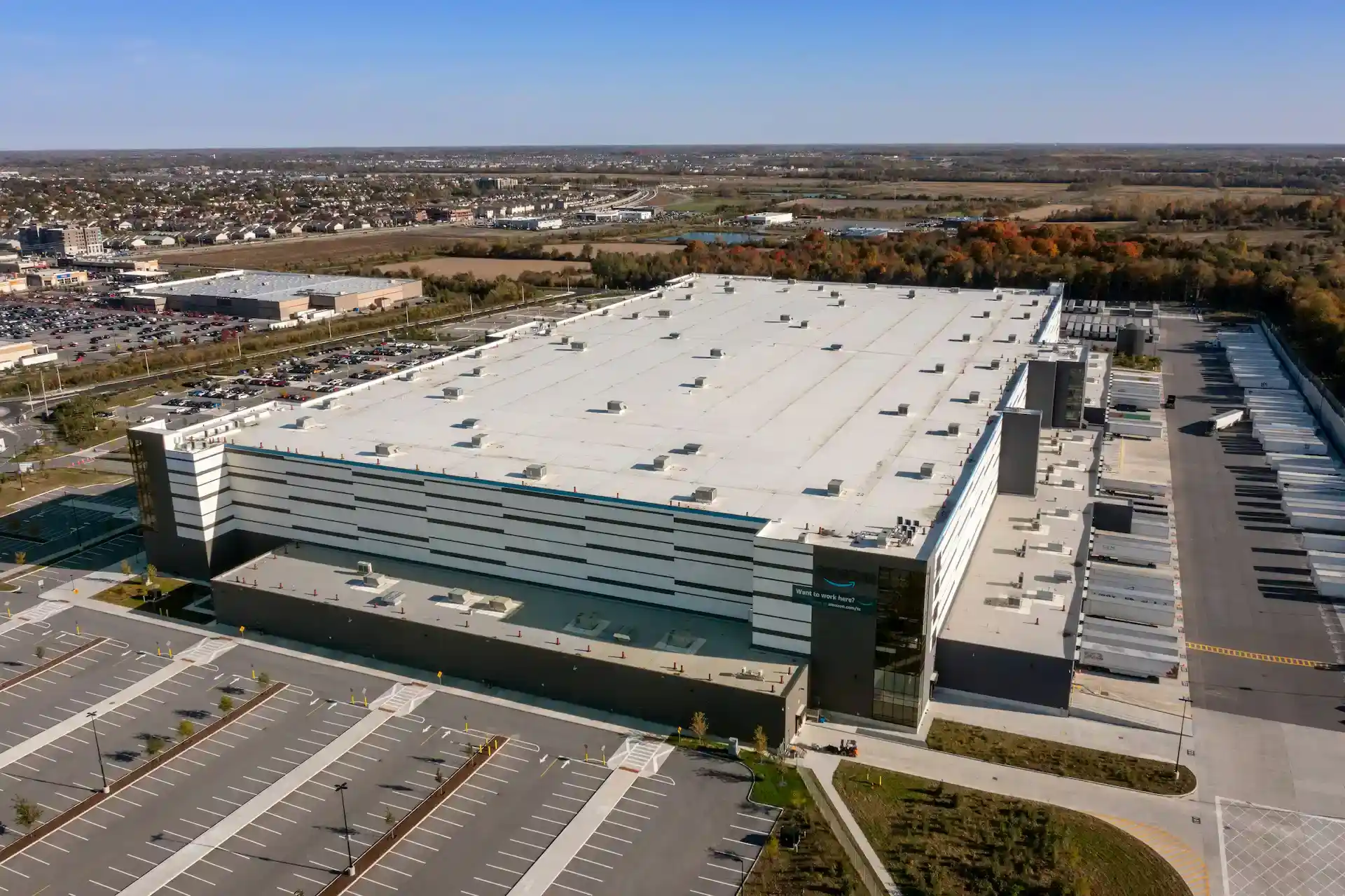
Amazon's massive fulfillment center on Akron's south side — one of the largest warehouse operations in Summit County — puts the challenge of commercial roofing into sharp relief. When a roof spans 800,000 square feet or more, every decision about membrane selection, drainage engineering, and flashing detail is multiplied thousands of times over, and a single engineering mistake can translate into hundreds of thousands of dollars in water damage to inventory, conveyor systems, and concrete floor slabs.
Drainage is the defining engineering problem for large warehouse and distribution footprints in Akron. Summit County averages roughly 38 inches of annual precipitation, and the flat or low-slope roofs common to fulfillment centers and industrial parks cannot rely on natural runoff the way a multifamily pitch can. Commercial roofing contractors serving Akron's warehouse district along Interstate corridor size internal drains and overflow scuppers to handle a 100-year storm event, not just average rainfall. Undersized drains create ponding water that accelerates membrane degradation and, in extreme events, can exceed structural live load limits.
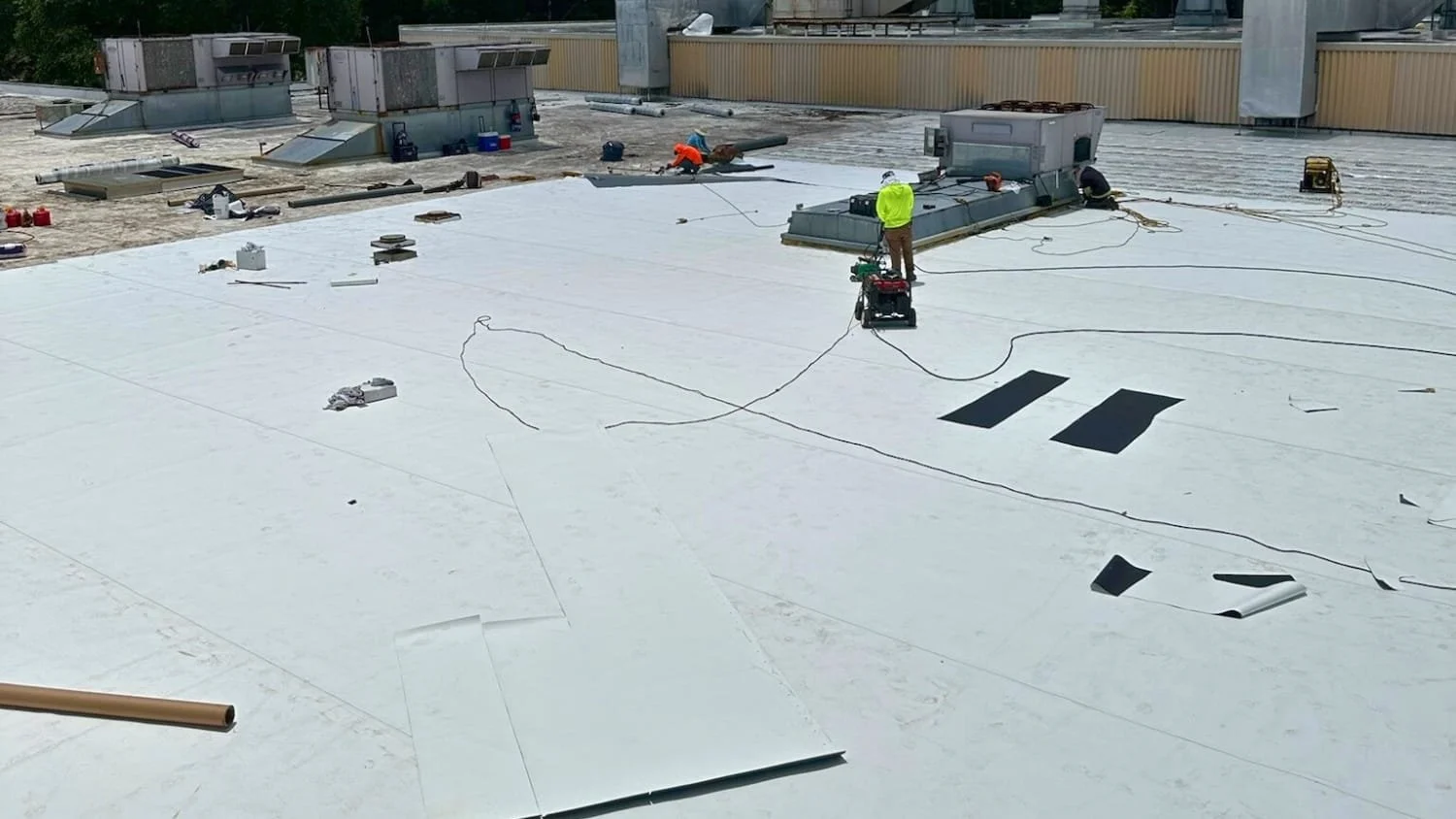
Membrane selection for Akron warehouses comes down to a contest between TPO and EPDM, with each material making sense in different situations. TPO — thermoplastic polyolefin — has become the dominant choice for new construction because heat-welded seams are nearly monolithic and the white surface delivers meaningful energy savings for climate-controlled distribution facilities. EPDM — ethylene propylene diene monomer — remains competitive in re-roofing projects where the existing substrate is irregular or where budget constraints favor a ballasted system. In northeastern Ohio, where freeze-thaw cycles can stress seam adhesives, the heat-welded TPO seam often outperforms EPDM tape-and-adhesive joints over a 20-year horizon.
Dock door and truck court penetrations are a detail that separates experienced warehouse roofers from general commercial contractors. At a large distribution center, loading docks line one or more entire building elevations, and the transition from the roof membrane to the dock canopy, dock shelter, and recessed dock pit creates dozens of complex flashing conditions. Each canopy-to-wall intersection must be flashed with sheet metal that accommodates thermal movement — Akron's temperature swing from January lows near 15°F to July highs near 85°F creates significant expansion and contraction — while maintaining a watertight seal against driven rain.
Rooftop ventilation and forklift exhaust equipment add additional penetration complexity to warehouse roofs. Large distribution centers in Akron run propane and electric forklifts whose exhaust or battery charging off-gassing must be removed from the building. Gravity ventilators, power exhausters, and make-up air units punch through the membrane at regular intervals, and each penetration requires a properly sized curb, a pitch pocket, or a prefabricated pipe boot depending on the unit's footprint and movement characteristics. Improperly flashed mechanical curbs are among the most common sources of warehouse roof leaks in the Summit County area.
Snow load is a serious structural and roofing consideration for Akron warehouses. Summit County sits in a region that receives lake-effect moisture from Lake Erie, and while Akron proper receives less snow than Cleveland's west side, accumulations of 18 to 24 inches on a flat warehouse roof create substantial weight. Responsible commercial roofers engineer drainage systems that handle meltwater volume and specify insulation board thicknesses that prevent ice dam formation at parapet walls and roof-to-wall transitions. Vapor retarder placement is also critical — in a heated warehouse with a cold roof deck, moisture drive from the interior can condense within the insulation assembly if the retarder is absent or improperly located.
Energy efficiency is a direct operating cost concern for Akron's climate-controlled warehouses. A white TPO membrane with high solar reflectance and thermal emittance reduces cooling load in summer months and, combined with adequate polyiso insulation, keeps heating costs manageable in winter. For distribution centers running refrigeration or climate-controlled zones, the roof assembly's R-value directly affects the mechanical system's sizing and annual energy spend. Several Akron warehouse operators have negotiated utility incentives through FirstEnergy's commercial efficiency programs by upgrading to high-performance roof assemblies during scheduled re-roofing cycles.
Cost per square foot for Warehouse and Distribution Center Roofing in Akron, OH in the Akron market typically ranges from $6 to $11 installed for a standard TPO recover over existing insulation, rising to $14 to $18 for a full tear-off with new ISO board on a large distribution center. These figures are meaningfully lower per square foot than smaller commercial projects because material quantities and crew mobilization costs are amortized across a much larger footprint. Akron contractors working the industrial corridor along State Route 8 and the I-77 interchange are accustomed to bidding at scale and can often deliver competitive pricing relative to Columbus or Cleveland markets for the same specification.
Preventive maintenance programs are the most cost-effective investment an Akron warehouse operator can make after the initial installation. Bi-annual inspections — one in spring after freeze-thaw season and one in fall before winter — catch membrane splits, open seams, and blocked drains before they become interior leaks. For a 500,000-square-foot facility, the difference between a $2,000 annual maintenance contract and a single undetected leak that damages $200,000 worth of inventory makes the math straightforward. Akron's established commercial roofing contractors offer standing service agreements that include priority response during the active storm season from April through October.
- What membrane is best for a large warehouse roof in Akron's climate?
- TPO is the preferred choice for most new and re-roofing projects because heat-welded seams handle freeze-thaw stress better than adhesive-bonded EPDM joints, and the white surface reduces cooling costs for climate-controlled distribution operations in Summit County.
- How are dock door penetrations properly flashed on a commercial warehouse?
- Each dock canopy-to-wall intersection requires custom sheet metal flashing engineered for Akron's temperature range — approximately 70°F seasonal swing — with expansion joints or slip conditions built in so thermal movement doesn't open seams or crack sealant over time.
- What snow load standards apply to flat warehouse roofs in Summit County?
- Akron-area warehouse roofs are designed to the ground snow load specified in ASCE 7 for Summit County, typically 25 psf, with structural engineers applying appropriate drift and drift-load factors for the building's geometry and surrounding obstructions.
- How much does it cost to re-roof a large distribution center in Akron?
- A TPO recover over existing insulation on a large warehouse typically runs $6 to $11 per square foot installed in the Akron market; full tear-off with new polyiso insulation board ranges from $14 to $18 per square foot depending on specification and substrate condition.
- How often should a warehouse roof in Akron be professionally inspected?
- Twice per year is the industry standard — once in spring after the freeze-thaw season to assess any winter damage, and once in fall before winter to ensure drains are clear and seams are tight ahead of snow and ice accumulation.