
CAPEX Roof Planning for Akron commercial properties
A first walk for the capital budget is a condition record, never a sales pitch. What earns a line in that record is drain behavior, parapet movement, insulation moisture, edge securement, and whether crews can work overhead without shutting down the business operating below.
Capital roof planning usually lands with an asset manager who has to defend a multi-year number. We shape the scope to that reality, because a roof near Ravenna may only allow short weather windows, while one near Twinsburg answers to truck courts, tenant doors, campus access, medical operations, airport-area traffic, or retail customers.
The pace of a capital plan tracks Northeast Ohio weather, and the local yardstick is roughly 41.57 inches of precipitation and 47.2 inches of snow a year in the 1991-2020 NWS Akron-Canton normals. Snow load, freeze-thaw, ice backup, drainage, and summer hail determine how fast a roof burns through its remaining service life. April, near 3.71 inches of precipitation and 1.8 inches of snow, opens a workable window, while January snowfall near 13.4 inches shuts it, and the plan is timed against both.
A capital plan cannot assume one Akron building pattern. Downtown Akron, the Main-Market Historic District, Cascade Plaza, Lock 3, Lock 4, Canal Park, Highland Square, Middlebury, the University of Akron, Summa Health, Akron Children's Hospital, Cleveland Clinic Akron General, Montrose, and the Akron-Canton Airport area each change the phasing and the priorities. A roof holding ponding water can sit next to a medical, campus, or industrial section, and the plan weighs each differently.
Roof spending rarely lands in a tidy budget year, which is why CAPEX Roof Planning matters for owners managing multiple buildings across Akron and Summit County. Mapping the remaining service life of each membrane against expected repair, recover, and replacement costs lets a facility team stage major work deliberately instead of scrambling for emergency capital after a Northeast Ohio winter forces the issue.
Capital roof work ties into I-76, I-77, SR-8, I-277, US-224, Arlington Road, East Market Street, West Market Street, Copley Road, and the Akron-Canton corridor. Around Downtown Akron, that means the plan has to anticipate truck access, membrane staging, rooftop equipment, future tenant work, snow-removal paths, and safe material delivery for each budget year.
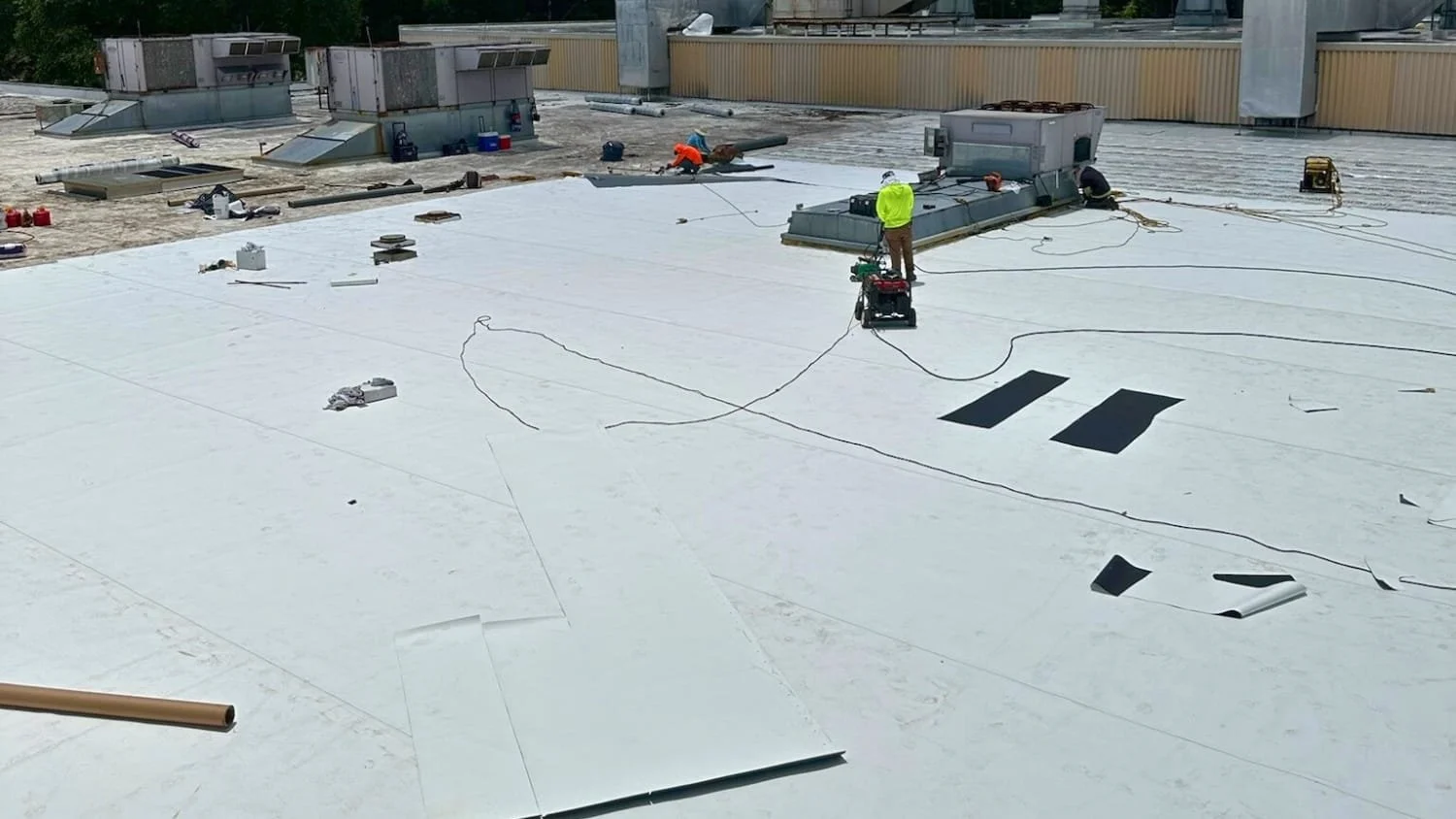
Planning happens one roof section at a time. The opening pass logs membrane type, age clues, rooftop equipment, ponding lines, drain strainers, edge-metal condition, wall transitions, pitch pockets, chemical exposure, tenant leak reports, and interior ceiling evidence. Should a core cut near the Ohio and Erie Canal Towpath Trail come up wet, both the timeline and the priority order shift to reflect it.
Four different interventions, repair, recover, coating, and replacement, occupy different tiers of a capital plan, and CAPEX Roof Planning keeps them from being averaged into a single meaningless figure. A roof with a sound deck and isolated seam failure belongs in a low-cost maintenance line, while one carrying wet insulation, deck damage, or failed slope needs its own replacement reserve set well before the leaks force a rushed decision.
The cost drivers behind a capital plan stay grounded in the practical: roof access, fall protection, tear-off volume, wet insulation, tapered insulation, drain work, coping, wall flashing, temporary protection, after-hours labor, wind exposure, and occupied-building staging. Each one gets flagged so ownership can see why a section along East Market Street ranks higher in the plan than an easier deck nearby.
Planning records matter when the spend touches insurance, public funds, tenant relations, campus operations, healthcare facilities, or an industrial plant. We provide roof-area notes, photo locations, scope limits, known exclusions, access constraints, and weather-sensitive details. On claim-related work, we document what the crew saw without acting as a public adjuster or promising any insurance outcome.
Sequencing protects the building while a capital plan is executed. Materials stay clear of drains, open sections are sized to the forecast, and close-in is decided before snow, hail, wind, or heavy rain arrives. Near Chapel Hill Business Park, a small open section can become an interior problem before the next weather break, so the phasing accounts for it.
We are ready to build the capital plan when the owner needs a repair figure, a maintenance track, or a multi-year budget tied to this roof and the wider Akron, Summit County, Cuyahoga Falls, Barberton, Fairlawn, Green, Stow, Hudson, Kent, Wadsworth, and Akron-Canton corridor. The output is a roof-specific plan, not a generic recommendation.
Our added pass on a capital plan reviews old patch records, roof traffic, maintenance logs, warranty paperwork, interior leak history, and freeze-thaw exposure that move the year-over-year spend. That record leaves the owner a plan grounded in this roof, not a square-foot quote with the assumptions left out.
Questions Owners Ask
What changes the realistic cost for CAPEX Roof Planning?
What drives a roof's place in the capital plan is its real condition, access, insulation moisture, deck integrity, edge metal, and drainage, rather than the age printed on a warranty certificate. CAPEX Roof Planning verifies those items on each building so the dollars assigned in a future budget year reflect the work the roof will actually require.
Can CAPEX Roof Planning be done while the building stays open?
Often, but every CAPEX line still has to be sequenced against operations. We review entrances, loading doors, roof access, noise, odor, weather windows, and safety zones so that funded work can be carried out during the day, in phases, or off-hours without forcing the building to shut down around it.
How do we decide between repair, recover, coating, and replacement for CAPEX Roof Planning?
CAPEX planning is grounded in roof condition: moisture, deck condition, attachment, slope, seam condition, drain performance, winter exposure, and edge-metal risk. Roofs reading dry and stable can be deferred as maintenance in the CAPEX schedule; roofs where moisture is spreading are pulled forward as replacement capital.
What documentation is included after a CAPEX Roof Planning inspection?
The CAPEX documentation captures roof-area notes, photo locations, leak and damage observations, priority levels, repair limits, access constraints, and budget categories so each roof carries a numbered, defensible spot in the plan. Storm damage is recorded as contractor-side evidence without promises about claim outcomes.
How quickly can you look at CAPEX Roof Planning after a winter storm or hail event?
Sequencing capital work depends on access, weather, crew availability, and whether any roof is admitting water. We move roofs with active intrusion to the front of the plan, then distinguish short-term dry-in spend from the larger replacement figures scheduled across coming budget cycles.