TPO Single-Ply Roofing in Akron, OH for Akron commercial properties
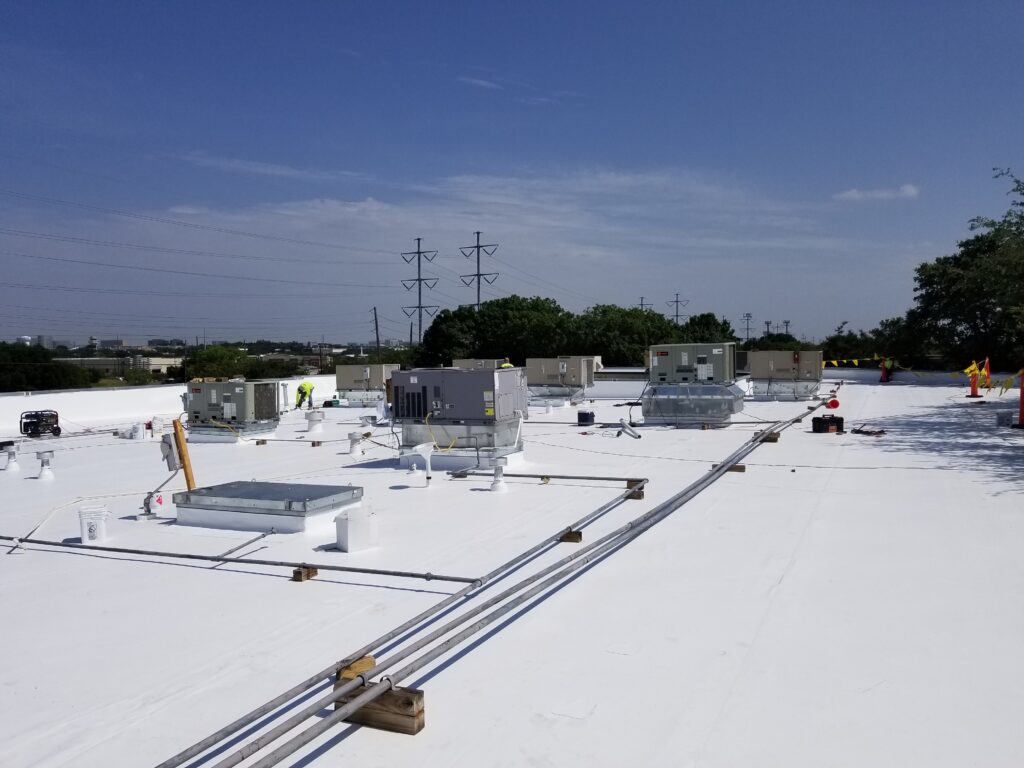
TPO — thermoplastic polyolefin — has become the dominant single-ply specification for new commercial roofing in Akron and across northeast Ohio over the past two decades, and the reasons are grounded in the specific performance requirements of this market. White reflective TPO provides meaningful cooling energy reduction in Akron's moderate summers. Its factory-welded seams provide superior seam integrity compared to adhesive-bonded EPDM seams in a freeze-thaw climate. Its heat-weld repairability makes field repairs fast and reliable. And its availability in 60-mil and 80-mil thicknesses provides the impact resistance appropriate to the hail exposure and rooftop traffic loads that Akron's commercial buildings experience. When we specify TPO for a University of Akron building, a Bounce Innovation Hub installation, or a Port Green Industrial facility, we are selecting the material that most consistently delivers warranted performance in Summit County's specific climate and institutional context.
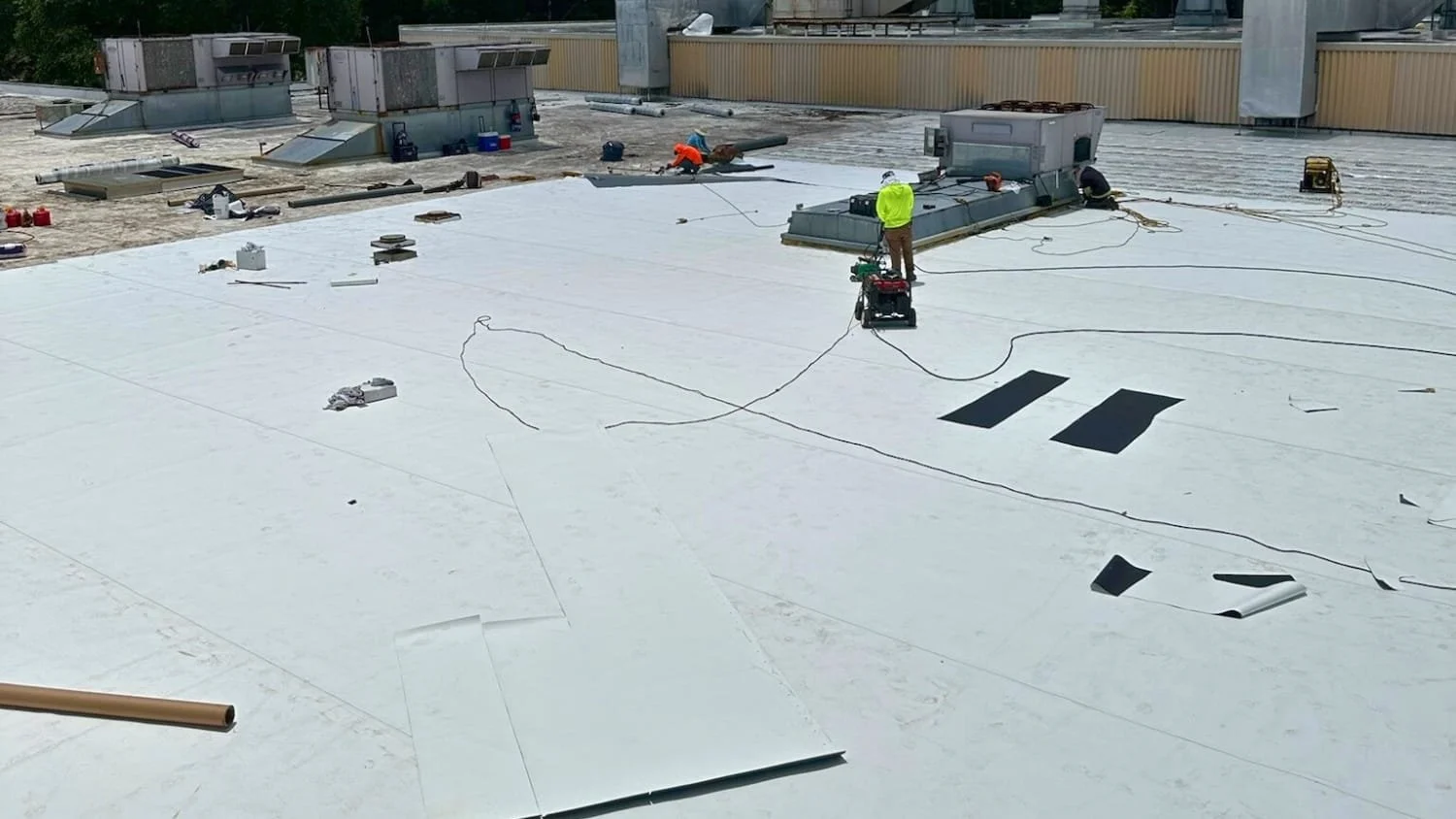
Seam integrity in freeze-thaw cycling is the technical argument that best explains TPO's dominance over EPDM in Akron's new commercial construction market. EPDM's adhesive seam system — even with modern seam tape and splice adhesive — relies on a bond between dissimilar materials (adhesive and membrane) that is subject to fatigue from repeated expansion-contraction cycles. TPO's hot-air welded seam fuses two TPO layers into a single thermoplastic mass with bond strength equal to or exceeding the membrane itself — there is no adhesive interface to fatigue. In Akron's climate, where a commercial rooftop may experience 200 or more meaningful thermal cycles between November and April, the difference between an adhesive seam and a welded seam compounds over the system's service life in a way that consistently favors TPO's performance longevity in this market.
The 60-mil versus 80-mil TPO thickness question deserves a direct answer for Akron's commercial context: we specify 60-mil as the minimum for any Summit County commercial installation, and 80-mil where the specific building conditions warrant the additional investment. The case for 80-mil is strongest at three building types: University of Akron research facilities (high foot-traffic from lab maintenance personnel), Port Green Industrial buildings (fork truck vibration and maintenance traffic), and any building in the Fairlawn-Bath or CAK-area zone with documented hail exposure history. The incremental cost of 80-mil over 60-mil is approximately $0.60–$0.80 per square foot on a typical commercial project — a modest premium relative to the total project cost that substantially reduces the likelihood of mechanical damage or hail-puncture repair calls over the system's service life.
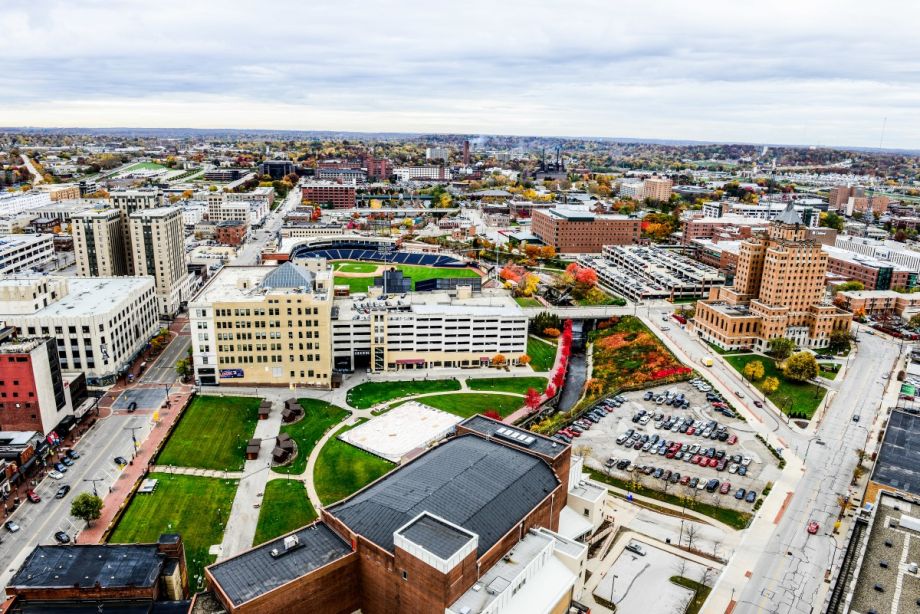
University of Akron's polymer science campus represents Akron's most technically demanding TPO installation environment. The research labs and engineering facilities have rooftop exhaust configurations, penetration densities, and access patterns that require precise flashing work and careful installer execution. Beyond the technical complexity, the university's procurement requirements — contractor prequalification, insurance documentation, Ohio prevailing wage compliance on public university projects, and facilities management coordination — create an administrative dimension that not all commercial contractors are equipped to navigate. Our teams carry current UA contractor certifications and are familiar with the university's project documentation requirements, which substantially reduces friction in the bidding and execution process on campus projects.
Bounce Innovation Hub, operating within the UA innovation ecosystem, serves a mix of early-stage businesses and research programs that have both the institutional connection of the university environment and the operational urgency of commercial enterprise. Rooftop work on the Bounce building requires the same institutional coordination as UA's academic facilities but with the added awareness that tenant businesses operating inside have tight operational margins — a roof work scheduling conflict that interrupts a critical product demonstration or customer meeting matters to a startup in a way it might not to an established corporation. We coordinate TPO installation and maintenance schedules for Bounce with the building management team, scheduling work to avoid conflicts with major tenant events and providing advance notice when work will involve noise, equipment staging, or access restrictions.
Port Green Industrial Park's large-format buildings — distribution centers, warehouse spaces, and light manufacturing facilities — are the highest-volume TPO installation environment in the Akron market. These buildings have large, relatively simple flat-roof areas with steel-deck substrates, standard polyiso insulation, and moderate penetration counts. For these buildings, installation efficiency and warranty compliance are the primary quality metrics: consistent weld quality across thousands of linear feet of seams, complete probe testing documentation, and correct attachment pattern spacing for the specific wind uplift zone. We have installed and maintained TPO systems throughout Port Green and carry the installation history for each building — useful when a future repair or inspection requires knowing the specific attachment system, membrane thickness, and insulation assembly of the original installation.
TPO membrane quality varies significantly across manufacturers and has been a topic of industry concern since some early-generation formulations in the 2000s showed premature aging. The industry has largely addressed formulation quality issues through evolved standards and competitive pressure, but specification from a reputable manufacturer with a documented warranty track record remains important. We specify TPO from manufacturers with established NDL warranty programs, tested seam-weld compatibility between field membrane and accessories (flashings, cover tape, accessories must be from the same manufacturer for seam weld compatibility), and factory field representatives available to support large-project inspections. For any TPO project seeking NDL warranty coverage in Summit County, manufacturer representative inspection at seam completion is standard procedure in our project workflow.
Reflectivity maintenance is a practical consideration for Akron TPO installations that building owners should understand when they begin a maintenance program. White TPO surfaces accumulate soiling from atmospheric deposition, biological growth (algae), and in industrial areas, process exhaust residue. Soiling reduces reflectivity measurably over time — initial SRI values of 100+ can decline to 70–80 within five years without cleaning. Annual or biennial cleaning with appropriate low-pressure washing and mild detergent maintains reflectivity close to initial values and provides the additional benefit of a close-up surface inspection during the cleaning process. We include TPO surface cleaning as a scheduled item in maintenance programs for all white TPO installations.
Questions Owners Ask
Why does TPO sometimes blister or wrinkle after installation?
Post-installation blistering in TPO is almost always caused by moisture trapped in the assembly below the membrane — either wet insulation that was not detected before installation, or moisture that infiltrated during installation through an inadequate temporary protection sequence. Wrinkles (non-blister surface undulations) in mechanically attached TPO are typically caused by thermal expansion of the membrane in hot weather, which is normal and not a performance concern in standard mechanically attached assemblies — the membrane is designed to have some thermal movement freedom. Persistent large wrinkles or wrinkles in fully adhered sections indicate adhesion problems that should be investigated. Both conditions are assessed during maintenance inspection and characterized as either normal or requiring attention.
What is the expected service life for TPO installed in Akron's climate?
Properly specified and installed 60-mil TPO with heat-welded seams carries manufacturer NDL warranties of 15–20 years and real-world service life in northeast Ohio's climate that commonly reaches 20–25 years with proper maintenance. Service life is most directly affected by seam quality (poorly welded seams shorten service life dramatically), membrane thickness (thicker membranes resist mechanical damage better), and maintenance program quality (drain-cleared roofs outlast drain-neglected roofs by years). The 80-mil specification, maintained properly, can reach 25–30 years in Summit County's climate.
Can TPO be installed over an existing EPDM system without tear-off?
Yes — TPO can be specified in a recover assembly over qualifying existing EPDM, subject to the standard moisture scan and core assessment requirements for any recover project. The recovery board layer separates the new TPO from the existing EPDM substrate and provides the required weld substrate compatibility. From a material compatibility standpoint, the primary consideration is that the TPO heat-weld equipment settings used for field seams cannot be used for the TPO-to-EPDM interface — all TPO-to-substrate connections in a recover are made through the recovery board and attachment system, not through weld bonding to the EPDM surface. We review the specific recovery assembly design with the membrane manufacturer before any TPO-over-EPDM recover project to confirm warranty qualification.
What causes TPO seam failures on older systems?
TPO seam failures on older systems (10+ years) fall into two categories: installation-era quality issues and thermal cycling fatigue. Early-generation TPO (pre-2010) seams from some manufacturers are known to have had formulation issues that reduced seam strength over time; if your building has older TPO with a documented manufacturer history of seam problems, a seam condition assessment is worth initiating. Thermal cycling fatigue on properly manufactured TPO is rare before 15 years but can appear at high-stress locations — inside corners, at penetration flashings, at edge metal termination points — where the membrane geometry concentrates thermal movement stress. These are repaired with cover tape heat-welded over the failed area.
Does TPO Single-Ply Roofing in Akron, OH require specific maintenance in Akron's winter climate?
TPO requires the same twice-annual maintenance cadence as any Akron commercial flat roof: spring post-freeze inspection with drain clearing and deficiency repair, and fall pre-freeze inspection with drain clearing, seam inspection, and sealant replacement at all penetration terminations. There is no TPO-specific winter maintenance protocol beyond these standard items. Heat welding for repairs is temperature-limited (substrate above 40°F), so cold-season repairs use cover tape with mechanical fastening as a temporary measure and are upgraded to heat-welded covers when conditions allow. TPO's material performance in winter is excellent — cold-temperature flexibility is one of its specification strengths for this climate.