
Automotive Manufacturing Facility Roofing for Akron commercial properties
The hard part of an automotive plant roof is not the roofing. It is doing the roofing across hundreds of thousands of square feet while a line runs underneath at a cost-per-hour the plant has already calculated. Everything about how we approach these buildings in Akron flows from that one fact: the work has to advance steadily without ever putting production at risk, and the logistics of getting there are most of the job.
Akron's automotive base is supplier-heavy, which shapes the work as much as a final-assembly plant would. The region grew up making tires and rubber, and that legacy lives on in the polymer, sealing, hose, and component plants tied to Bridgestone, Goodyear's local operations, and the Tier 1 and Tier 2 suppliers feeding the broader Ohio assembly network along I-76, I-77, and the Route 8 industrial belt. These plants run continuous shifts and just-in-time schedules with no slack, so a roofing disruption ripples straight downstream to a customer.
Very large decks demand real phasing
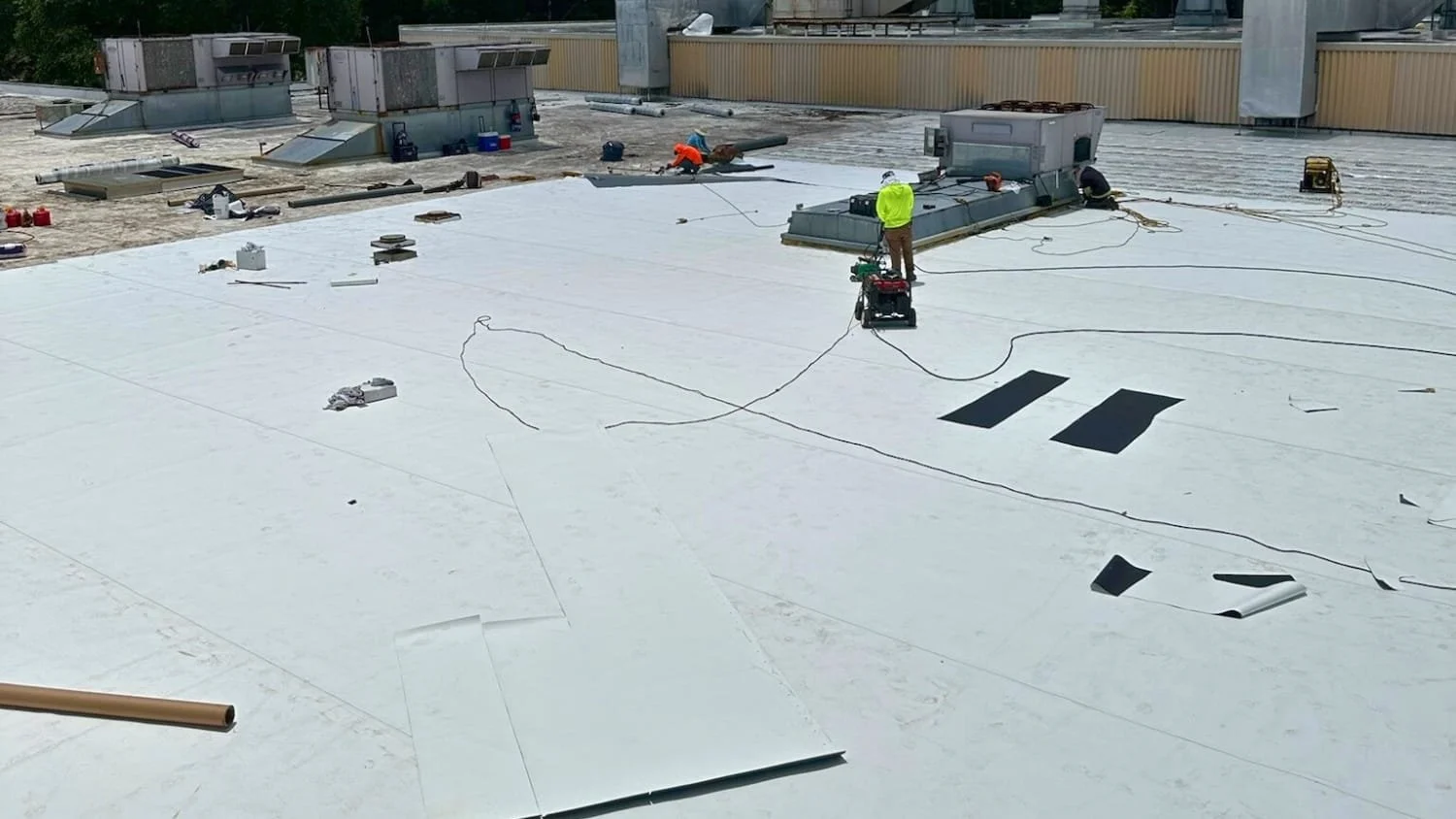
An automotive or major supplier plant can put hundreds of thousands of square feet of roof under one envelope. You cannot tear that off the way you would a strip center. We section the roof into manageable zones, sequence tear-off and new-roof installation so we never open more than we can dry in before weather, and stage material delivery and crane picks around the storage and access the live plant actually allows. Daily watertight dry-in is confirmed before every shift change, and we keep direct contact with the plant's maintenance lead so the active phase always stays clear of the lines running below.
Dense ventilation and process loads
A manufacturing roof is crowded. Process exhaust, make-up air units, dust and fume collection, compressed-air and process piping, and large rooftop HVAC all penetrate the membrane in dense clusters, and each one is a flashing detail and a potential leak path. Many also concentrate real structural load on the deck. Before we set insulation thickness or a new system, we confirm the existing deck can carry what is already up there plus anything the reroof adds, and we flash every penetration as its own item rather than running a generic field detail past a hundred curbs.
- Process exhaust, make-up air, and dust/fume collection stacks venting the production floor
- Large rooftop HVAC and process equipment concentrating structural load on the deck
- Compressed-air, hydraulic, and process piping penetrations clustered across the field
- Paint-shop zones with solvent vapor and strict hot-work limits
Paint shops change the rules
Where a plant runs a paint or coating operation, the roof above it is a different job. Solvent vapor and the fire-suppression requirements around paint mean hot work — torch, grinder, certain welding — is restricted or prohibited over and near those zones, and solvent-based roofing adhesives are not acceptable above active paint. We build the hot-work permit plan with the plant's EHS team during pre-construction and specify cold-applied adhesive or mechanical attachment over paint-adjacent areas so the membrane goes down without an open flame. These limits are not surprises; they are standard scope on an automotive roof.
Press vibration and seam fatigue
Stamping, casting, and powertrain operations transmit vibration up through the structure to the roof. Over a heavy stamping line, that constant low-frequency movement can fatigue a membrane seam that was bonded or welded without it in mind. On press-adjacent zones we tighten the seam and flashing detail and the welding procedure to account for the vibration the equipment actually generates, rather than relying on a standard seam that was fine on a quiet office roof.
Process loads, drainage, and Ohio weather
Years of equipment additions, roof-mounted piping, and re-routed drainage leave most older automotive roofs with low spots that pond. Standing water through an Akron freeze-thaw winter is a fast route from a minor seam issue to an active leak over equipment. We re-establish positive drainage with tapered insulation, correct undersized or buried drains and scuppers, and get water off the field before it can sit and work into the assembly above a running process.
The documentation the plant's engineers expect
OEM and large supplier facilities run on paperwork. We deliver a closeout package made to their standards: contractor safety qualification, a site-specific safety plan, warranty registration, a roof-zone diagram with a penetration inventory, daily reports, permit records, and a photographed condition survey, formatted the way the plant's facility engineering group asks for it so it drops straight into their records.
Automotive Manufacturing Facility Roofing Questions
How do you reroof without stopping the line?
We section the roof into zones and sequence tear-off and installation so the active phase stays clear of the lines below, staging material and crane picks around what the live plant allows. We confirm a watertight dry-in before every shift change and keep direct contact with the plant's maintenance lead throughout.
How do you handle the roof over a paint shop?
We build the hot-work permit plan with the plant's EHS team in pre-construction and specify cold-applied adhesive or mechanical attachment over paint-adjacent zones, since torch and grinder work is restricted and solvent-based adhesives aren't acceptable above active paint. We treat those limits as standard scope, not surprises.
Can the existing deck carry a new roof system?
We confirm it before setting insulation thickness or a new system. Manufacturing roofs already carry heavy process equipment and piping, so we verify the deck can handle what's up there plus anything the reroof adds, and flash every penetration as its own detail.
What about vibration from stamping presses?
Heavy presses transmit low-frequency vibration up to the roof that can fatigue seams bonded without it in mind. On press-adjacent zones we tighten the seam, flashing, and welding procedure to the vibration the equipment actually generates instead of using a standard quiet-building seam.
Do you work on Tier 1 and Tier 2 supplier plants too?
Yes, and they're much of our automotive work in Akron. Suppliers run just-in-time schedules with zero tolerance for interruption, so we coordinate the same way as an OEM plant — documenting the production schedule, phasing the roof around it, and keeping daily contact with the facility's point of contact.