
Snow and Ice Damage Roof Repair in Akron, OH for Akron commercial properties
Of all the roofing services offered in the Akron commercial market, snow and ice damage repair is the one most directly defined by this city's specific climate. Akron receives 47.2 inches of annual snowfall — significantly more than Columbus, Cincinnati, or Dayton — and concentrates the heaviest accumulation in January (13.4 inches average) and February (12.0 inches average). Those two months, combined with the sustained freeze-thaw cycling that characterizes every northeast Ohio winter from November through March, create a damage accumulation profile that makes spring the busiest repair season in Summit County's commercial roofing calendar. Understanding what Akron's winter actually does to commercial roofing systems — and how to repair it correctly — is a core competency for any contractor serving this market.
Ice damming is the snow-and-ice damage mechanism that Akron building owners most visibly encounter. It forms when a thermal gradient exists between the interior of the building and the rooftop: heat escaping from the building warms the roof deck, melts the bottom layer of accumulated snow, and the melt water runs toward the cold perimeter where it refreezes into a growing ice dam. The ice dam prevents further melt water from draining and forces it back under the membrane, flashing, or through any available gap. On multifamily buildings, ice dams famously work under shingles. On commercial flat roofs, the equivalent mechanism is ice backup at blocked or frozen drains, at parapet base flashings, and at any low area where melt water cannot drain freely. The resulting water infiltration appears as interior leaks weeks or months after the ice event, often in locations that are not directly below the rooftop ice formation.
Flashing failure from freeze-thaw cycling is the snow-and-ice damage pattern that generates the most service calls in Akron each spring. Every penetration base flashing, parapet base flashing, and edge metal termination on a commercial building experiences hundreds of freeze-thaw cycles in a typical Akron winter. Adhesive-bonded terminations — where sealant, caulk, or contact adhesive holds a flashing edge against a substrate — are particularly vulnerable: the adhesive bond fails gradually under repeated cycling stress, and the flashing lifts slightly with each cycle. By February or March, these marginally adhesed terminations have opened enough to allow snowmelt infiltration under the flashing. The repair is straightforward — cleaned surface, new adhesive or mechanical fastening, fresh sealant — but the scope can be extensive on an older building that has accumulated years of marginal conditions.
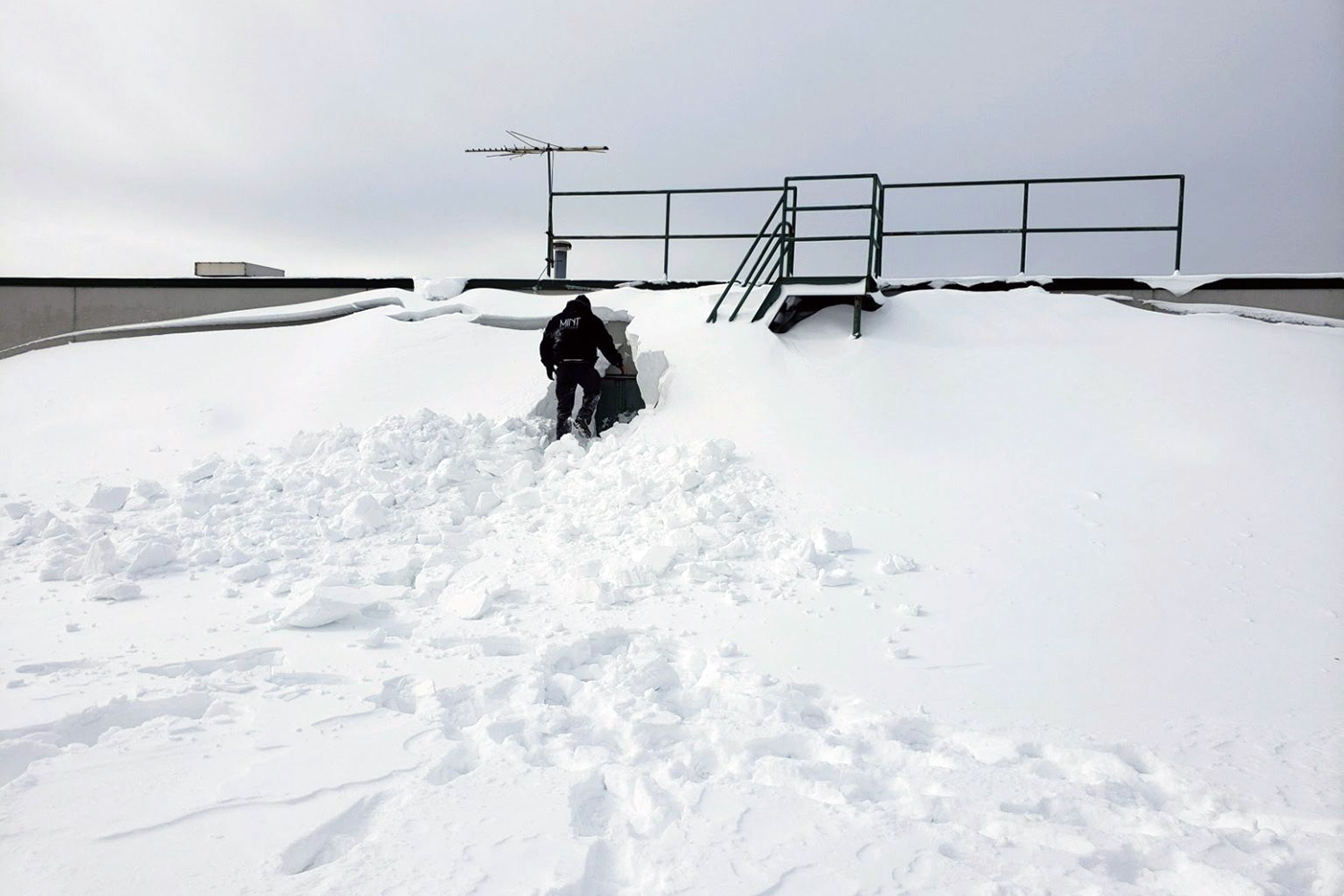
Snow load damage — actual structural distress from the weight of accumulated snow — is less common but the most serious manifestation of Akron's snow climate. Building codes specify design snow loads for Summit County based on ground snow load standards; Akron's design ground snow load is 20 pounds per square foot, with the roof snow load factor applied based on roof geometry, exposure, and occupancy. Modern buildings designed to current code have structural margins that accommodate typical Akron accumulations. Older buildings — particularly the light-gauge steel buildings of the 1970s and 1980s in suburban business parks, and some of the older light industrial buildings in the multifamily-adjacent neighborhoods — may have structural systems with smaller margins that are stressed by unusual accumulation events or by drift loading where snow blows off one section and concentrates on another. We assess structural conditions as part of emergency snow-damage calls and stop work on any roof section that shows deflection, cracking, or other evidence of structural distress until engineering assessment is complete.
Akron Children's Hospital and the Summa Health Akron campus have winter maintenance priorities that require an institutional-level response commitment. Both healthcare campuses operate critical patient care areas that cannot tolerate roof leaks, and both have rooftop mechanical systems that must continue operating through Akron's harshest winter conditions. Our winter response relationship with both campuses includes priority dispatch protocols, pre-established access procedures for after-hours calls, and the documentation requirements that both facilities' risk management teams require for any work on their buildings. A midnight call about a hospital roof leak is not a general contractor situation — it requires a roofing contractor with healthcare facility credentials, appropriate certifications, and established emergency protocols.
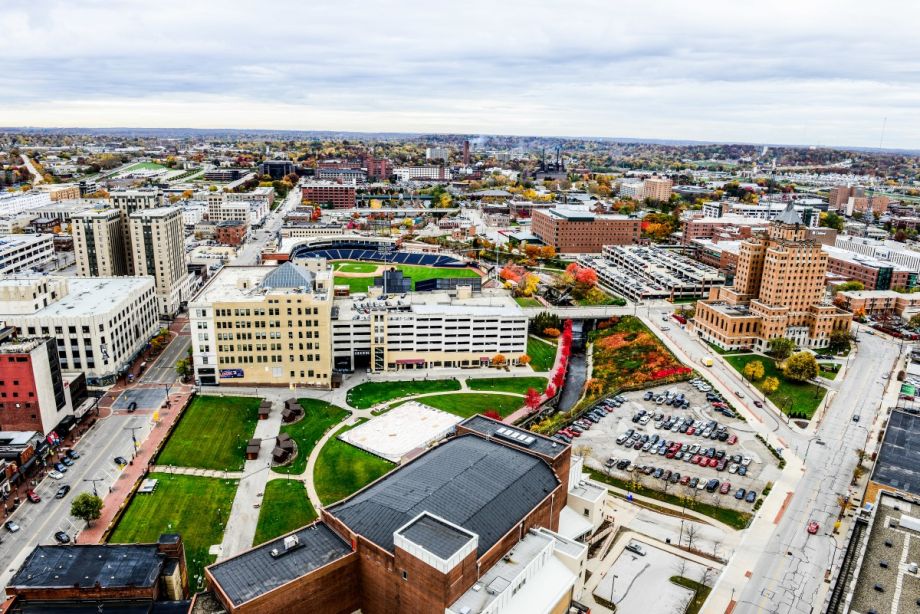
Downtown Akron's commercial buildings — the historic masonry and converted industrial buildings in the Main-Market Historic District, the Bowery, and the Cascade Plaza area — face ice and snow damage patterns specific to older building construction. Masonry parapets with original stone or metal coping experience frost heaving and joint opening from freeze-thaw cycling in the coping bed joints. Ice formation in open parapet joints can laterally displace coping stones or metal sections, creating both waterproofing failures and falling hazard conditions. We inspect parapet conditions specifically for ice-related displacement after significant winter events and document and repair displaced coping before spring pedestrian traffic resumes below the parapet.
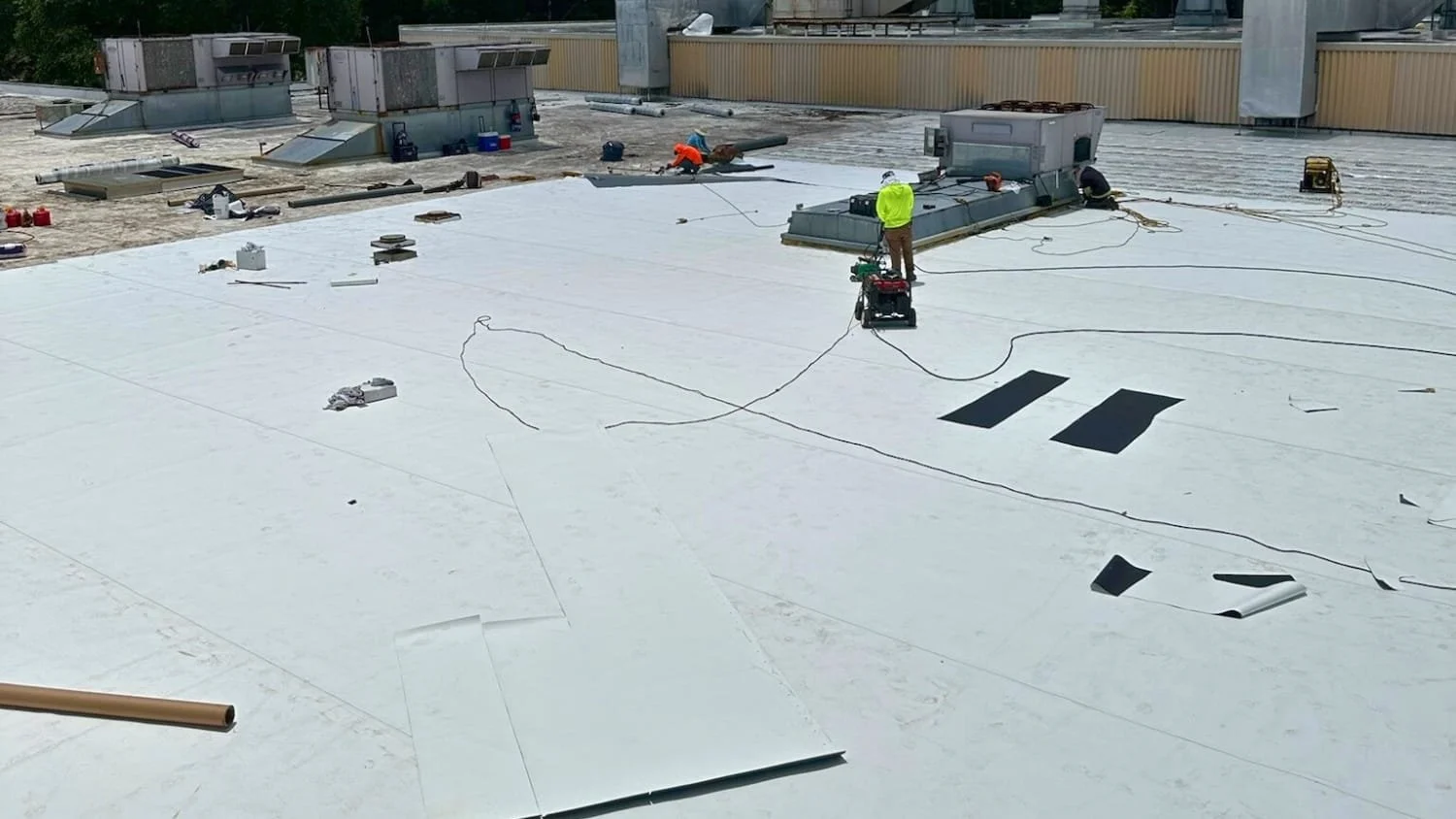
Repair execution for snow and ice damage requires patience in Akron's climate — the same conditions that caused the damage also constrain the repair. Adhesive-bonded flashing repairs require substrate temperatures above 40°F, which limits certain repairs to spring even when the damage was done in January. Torch-applied modified bitumen patches can be executed in colder conditions when performed by trained crew with appropriate equipment. Emergency closures using cold-process mastic and reinforcing fabric can be applied in near-freezing conditions to stop active infiltration while conditions are unsuitable for permanent repair. We match the repair approach to the temperature and weather conditions present, always with transparency about whether the repair is temporary (pending spring execution of permanent work) or permanent (viable in current conditions).
Documentation of snow and ice damage immediately after discovery is valuable for multiple purposes: insurance claim support, capital planning, maintenance program baseline, and future reference if the same area is damaged again. We provide post-damage inspection reports that include photographs, measurements, cause analysis, and repair recommendations for all snow and ice damage calls, regardless of whether the building owner decides to proceed with immediate repair or to defer to a scheduled program. The inspection report is yours to keep even if you choose a different contractor for the repair, because having the documentation of when and how damage occurred serves your interests regardless of who executes the repair.
Questions Owners Ask
Is snow removal from a commercial flat roof ever necessary in Akron?
Preventive snow removal is rarely necessary for modern buildings designed to current snow load codes. It becomes worth considering after extreme snowfall events (12+ inches in a single storm), when significant drifting has concentrated snow against parapet walls, or when an older building with a known structural margin concern receives accumulation that approaches the design threshold. We do not recommend routine snow removal as a general maintenance practice, but we do respond to building owners with specific structural concerns and can provide snow removal services or refer structural engineers for assessments. Emergency snow removal requires proper equipment and crew training — walking on a snow-loaded commercial roof without preparation is a personnel safety risk.
How do I distinguish between a snow-damage leak and a normal leak that just became visible in winter?
The distinction matters for insurance purposes and for identifying the correct repair scope. Snow-and-ice damage leaks typically have specific characteristics: they appear during or immediately after a snowmelt or freeze-thaw event; they are correlated with drain freeze-over or ice dam conditions; they often appear at perimeter flashings or drain areas rather than in open field areas; and they may stop leaking when temperatures drop and ice formation seals the breach. Normal wear-and-tear leaks tend to appear during rain events regardless of temperature and are often correlated with a specific membrane condition identified during inspection. We assess both possibilities in our diagnostic process and document our findings clearly for insurance purposes.
My building has ice forming on the exterior walls and icicles from the roof. Is that a sign of a roof problem?
Icicle formation along the exterior wall line or at drain discharge points indicates that roof drainage is flowing through a path — whether the intended drain or an unintended gap — and freezing at the building exterior. Heavy icicle formation at parapet scuppers indicates that the scupper or its outlet area is partially freezing, restricting flow and allowing water to spill at the freeze point. Icicle formation at the building base from wall-mounted drain discharge indicates the discharge is working but the freeze point is at grade rather than on the roof. Each pattern indicates a different issue, and we assess the specific icicle location and pattern to identify the drainage failure mode before recommending corrective action.
What causes a commercial roof to collapse from snow in Akron?
Roof collapse from snow loading is caused by a combination of snow accumulation that exceeds the structural system's design capacity and, often, pre-existing structural weakness from water damage or deferred maintenance. Buildings most at risk are those with older light-gauge steel framing systems, long-span roof structures, or documented prior water damage to structural members. Drift loading — where wind moves snow from an upper roof section to a lower adjacent section — can create local accumulations 3-4 times the average depth and is a common cause of localized overstress. If you observe unusual deflection, cracking sounds, door or window sticking during snow loading events, or water ponding in unusual locations, evacuate the affected area and call for a structural assessment immediately.
Can ice dam prevention be addressed without major construction?
Yes — the most cost-effective ice dam prevention approaches for existing Akron commercial buildings are: (1) heat cable installation in drains and drain pipes to prevent freeze-over of primary drainage; (2) improved attic or plenum insulation to reduce thermal gradient between interior and roof deck surface; (3) targeted drain clearing and pre-winter maintenance to ensure all drains are fully functional entering the freeze season; and (4) improved air sealing at penetrations that are allowing conditioned air to reach the underside of the roof deck. These measures address the conditions that create ice dams without requiring structural modifications. Major construction (re-insulation, drainage redesign) is appropriate when these measures are insufficient for the specific building's conditions.