

Roof Drains and Scuppers in Akron, OH for Akron commercial properties
Drain freeze-over is not a theoretical risk in Akron's commercial roofing world — it is a documented annual event on buildings throughout Summit County, from the older flat-roof industrial stock in Goodyear Heights to the newer single-ply commercial buildings along the Fairlawn-Bath corridor. When an interior roof drain's cast iron or PVC drain body cools below freezing through a combination of ambient temperature, rooftop wind exposure, and uninsulated pipe sections, and the water column above it forms a continuous ice plug, the drain ceases to function regardless of how clear its strainer basket is. January's 13.4 inches of average snowfall and February's 12.0 inches land on rooftops that are regularly freeze-draining into ice-plugged drain systems, with nowhere to go except to pond, back up against parapet flashings, and find the path of least resistance into the building assembly.
The engineering reality of snowmelt volume is rarely factored into commercial drain system evaluations, and it is a significant oversight in Akron's climate. A standard commercial drain sizing calculation for roof drainage is based on the design rainfall rate — typically 4 inches per hour for northeast Ohio — applied to the contributing roof area per drain. What that calculation does not account for is the snowmelt component: a 3-inch snowpack melting over 12 hours, simultaneously with a 1-inch rain event, produces a combined flow rate that exceeds the rainfall-only design flow. When this combined load arrives at a drain system sized only for rainfall, and when ambient temperatures are marginal for drain function, the overflow condition that results — water backing up across the roof membrane to the parapet scuppers and potentially over them — represents both a leak risk and a structural loading concern. We size drain systems using combined rainfall-plus-snowmelt loading for Summit County commercial projects.
Legacy industrial buildings in Akron's older commercial districts — the warehouses and manufacturing facilities in Goodyear Heights, along Kenmore Boulevard, and throughout the Firestone Park area — often have drainage systems that were designed for their original occupancy loads, which may not match current use or current precipitation loads. These buildings were frequently designed with interior drains connected to the combined sewer system that serves much of older Akron. The City of Akron and Summit County have been actively pursuing combined sewer separation projects, and some commercial buildings have been required or encouraged to separate their roof drainage from sanitary connections. We are familiar with Summit County's stormwater requirements and can advise on separation requirements and preferred discharge methods for older buildings with combined drain connections.
Overflow drain capacity is the safety-critical element of any commercial roof drainage system, and it is the element most commonly absent or undersized on older Akron buildings. Primary drains handle normal flow; overflow drains (or overflow scuppers) handle the condition where primary drains are partially or fully blocked. Building codes require overflow drainage capacity to be equivalent to the primary drain system, positioned 2 inches above the primary drain level so they engage only when primary drains are overwhelmed. Many older Akron commercial buildings have no overflow drains at all, relying on parapet scuppers of uncertain size or on the hope that primary drains never fail. When we assess commercial drainage systems, overflow capacity is a specific checklist item, and we document code-deficient conditions to support permitting and insurance conversations with building owners.
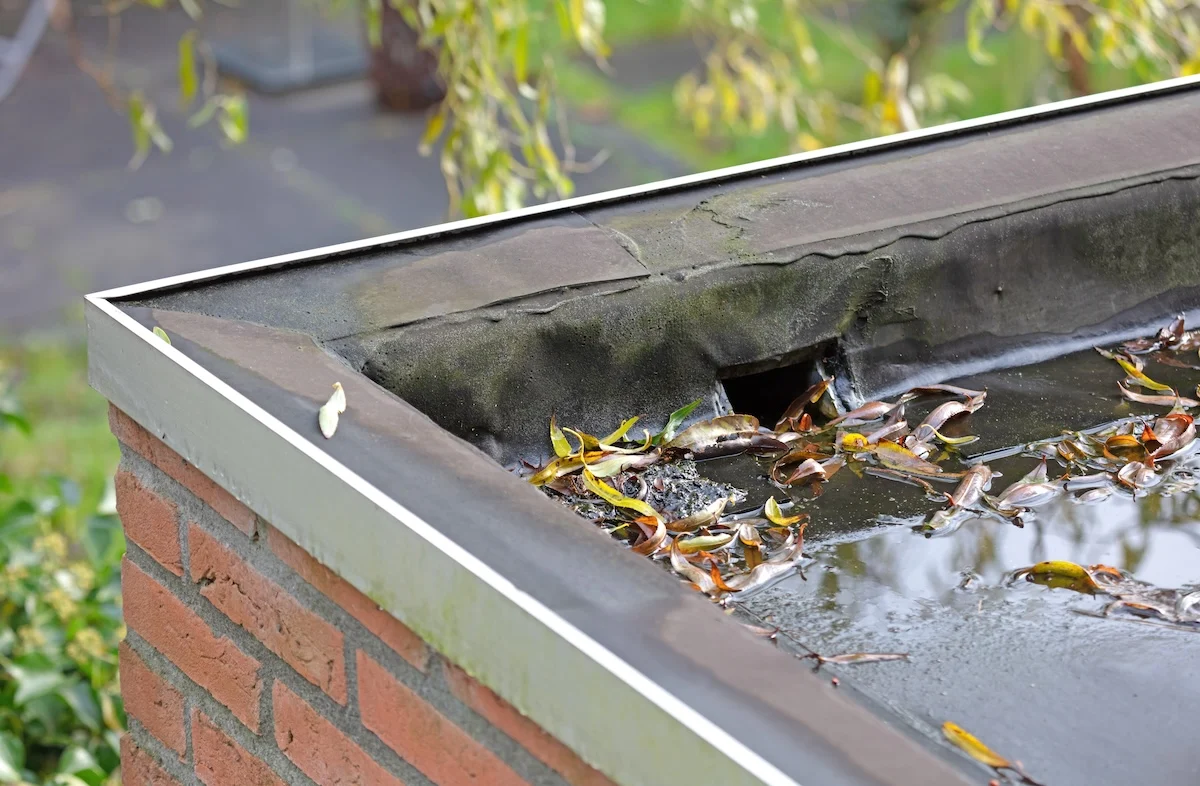
Scupper sizing and outlet protection are specific concerns for Akron's wall-discharge drainage systems. Masonry scuppers — openings through parapet walls — are sized during construction and can become restrictive as adjacent flashing or membrane materials settle and compress over decades. They can also become fully blocked by debris accumulation or, in winter, by ice formation at the outlet. Scupper outlets that discharge onto walkways, parking areas, or building entries create ice hazards when they freeze, and the ice formation can dam against the parapet and force water back through the scupper opening onto the roof surface. We evaluate scupper sizing, condition, and discharge location at every drainage assessment and recommend outlet extensions or deflectors when discharge locations create either ice hazard or erosion issues at grade.
Heat cable systems for drain freezing prevention are worth evaluating for any Akron commercial building with documented drain freeze-over history. Self-regulating heat cable installed in the drain body and the first 10–15 feet of the drain pipe provides freeze protection without constant power consumption — the cable's output increases as temperature drops and decreases as temperature rises. Modern drain deicing systems are energy-efficient, thermostatically controlled, and protected by GFCI circuits. The cost of a properly installed drain deicing system for a single interior drain — $800 to $1,500 installed depending on pipe configuration — is typically less than the cost of a single emergency roof repair caused by a freeze-over drainage failure. For buildings with multiple interior drains, the system cost scales proportionally but the value per drain remains favorable.
The drain strainer condition is the simplest and most accessible drainage maintenance item, and it is consistently among the most neglected. Cast iron dome strainers on commercial drains — the hemispherical screens that prevent large debris from entering the drain body — collect organic material, rooftop aggregate, and membrane granule shedding with every precipitation event. A strainer basket that is 50% blocked by organic accumulation reduces drain flow capacity by far more than 50%, because the flow restriction is not simply area — it is velocity and head pressure interacting with a partially clogged screen. Strainer clearing is included in every preventive maintenance visit and can be performed independently on a monthly basis by building maintenance staff at facilities with heavy organic debris loads (buildings adjacent to mature tree canopy, for example).
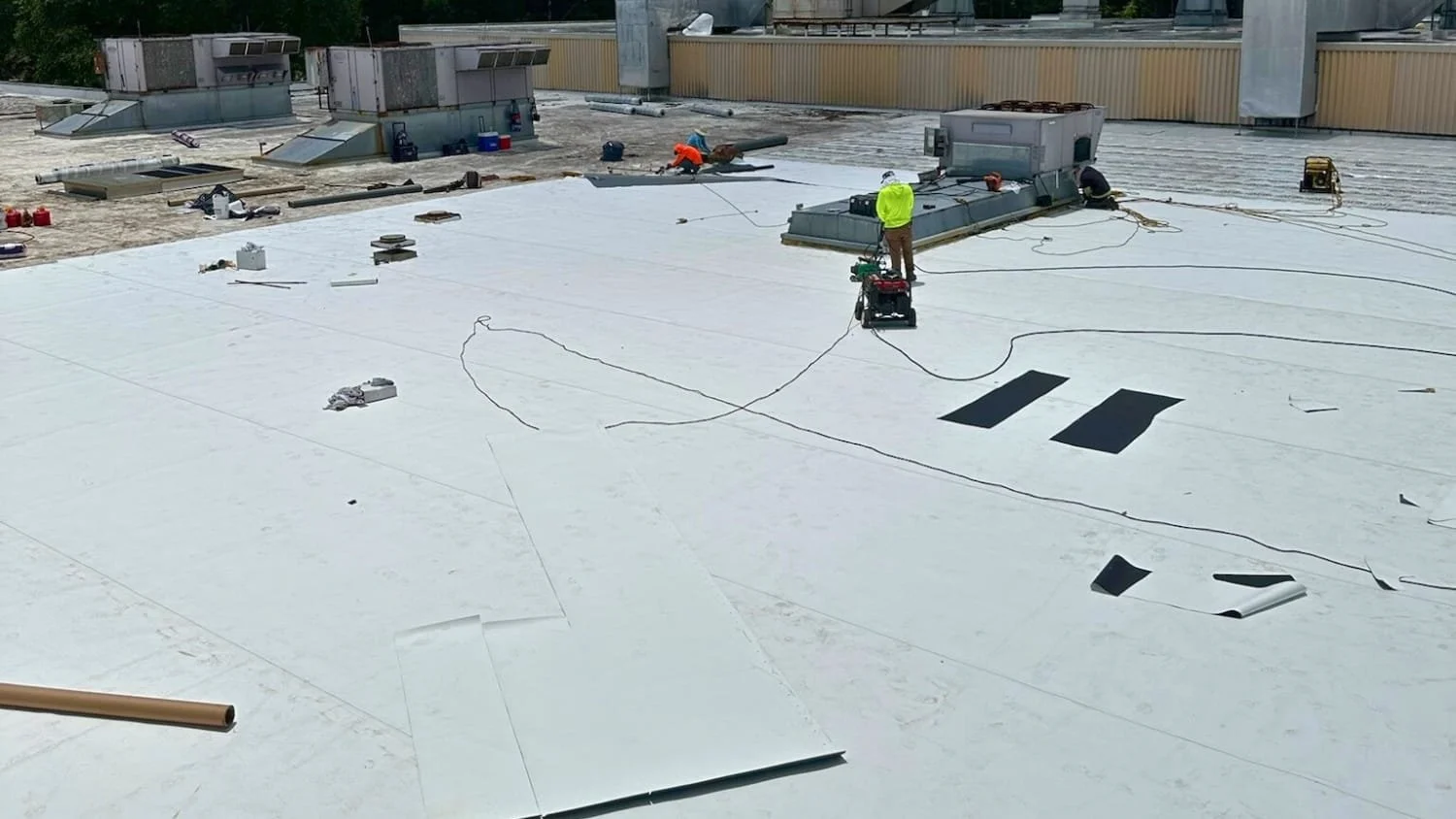
For commercial buildings undergoing significant reroofing — whether recover or full replacement — drain upgrade is often the highest-value scope addition. Adding drains to buildings with inadequate drain density, upgrading undersized drain bodies to commercial-grade cast iron or stainless steel, adding overflow drains where none exist, and replacing deteriorated drain flashing rings with new units that properly integrate with the new membrane all address the drainage system comprehensively while the roof is already open. Drain work done as part of a reroofing project costs far less than drain work executed on a standing roof, and the new drain-to-membrane interface is cleaner and more reliable when both components are installed as a system rather than adapted to each other.
Questions Owners Ask
How many roof drains does my Akron commercial building need?
Commercial roofing drain density is determined by the contributing area per drain, calculated from the roof geometry and the design rainfall rate. Ohio's building code references ASCE 7 rainfall intensity maps and requires enough drain capacity to handle the design storm without water accumulation exceeding the structural system's design live load. A rough guideline for Akron's design rain rate is one commercial drain per 4,000–5,000 square feet of contributing area, but the actual number depends on the specific slope configuration. We conduct a drainage analysis for any reroofing project and recommend drain additions where density is inadequate.
My roof has scuppers but no interior drains. Is that an adequate drainage system?
Scupper-only drainage systems are acceptable when the scuppers are properly sized, unobstructed, and positioned to drain the entire roof area by gravity toward them. Many older Akron masonry commercial buildings were originally designed with scupper-only drainage. The adequacy of the existing system should be evaluated against current drainage loading — if the scuppers were sized in 1960 and the building has since added rooftop HVAC equipment that redirects drainage patterns, the original sizing may be inadequate. We evaluate scupper systems using the same combined rainfall-and-snowmelt loading methodology we apply to interior drain systems.
What is the difference between a primary and an overflow drain?
A primary drain is the main drainage outlet, typically installed at the low point of a drainage area with its inlet at membrane level. An overflow drain (or secondary drain) is an additional outlet positioned 2 inches above the primary drain level that only engages when the primary drain is blocked or overwhelmed — it prevents catastrophic water accumulation on a roof with a failed primary drain. The IBC requires both primary and secondary drainage for most commercial flat-roof assemblies. In Akron's climate, where drain freeze-over and debris blockage are routine, having functional overflow capacity is a life-safety issue, not just a code compliance matter.
What causes a roof drain to become permanently slow even after cleaning?
Persistent slow drainage after strainer cleaning usually indicates a blockage further down the pipe — most commonly at a horizontal-to-vertical transition where debris accumulates, at a poorly sloped horizontal run where sediment has deposited, or at a deteriorated expansion joint in the drain pipe connection. Building settlement can also cause previously adequate drain slope to become inadequate over time. We use drain camera inspection when persistent slow drainage cannot be resolved by strainer cleaning, which quickly identifies the location and nature of the blockage without requiring exploratory demolition of the drain connection.
Can I add heat cable to existing roof drains without opening the roof?
Self-regulating heat cable can be inserted into existing drain bodies and pipe runs through the strainer opening, in most cases without disturbing the roofing membrane. The cable runs down the drain pipe to the first heated building interior, providing freeze protection to the most vulnerable exterior section of the drain assembly. Power connections to a GFCI-protected circuit at the rooftop are the only modification required. This is a non-invasive retrofit that can be completed in a few hours per drain and is often the most practical solution for Akron buildings with freeze-over history where drain repositioning or replacement is not warranted.