

Self-Storage Facility Roofing in Akron, OH for Akron commercial properties
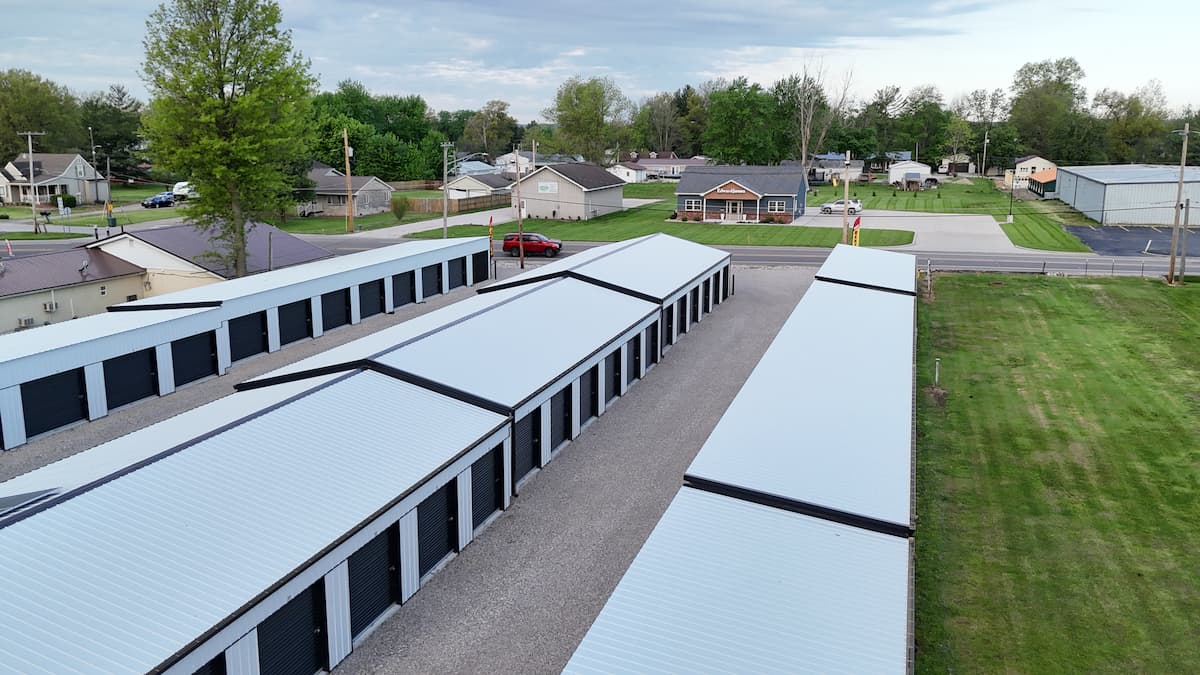
Public Storage on South Arlington Road in Akron, Ohio operates one of the larger self-storage campuses in Summit County, with dozens of single-story buildings spread across several acres of paved lot. Facilities like this one present a deceptively straightforward roofing challenge: the footprints are simple, the roof slopes are minimal, and the deck is typically steel — but when you multiply that across fifteen or twenty individual structures, the coordination and sequencing demands stack up fast. Commercial roofing contractors working in Akron understand that a storage campus job is not a single-building project wearing a costume.
Akron sits in the northeastern Ohio snow belt, where lake-effect precipitation from Lake Erie can deposit significant accumulation over short periods. Self-storage buildings with low-slope roofs and long, uninterrupted spans are particularly vulnerable to ponding water when internal drains clog with debris. Akron roofing contractors specify positive drainage slopes and oversized drain bodies on storage facility projects because the cost of a single interior flood — destroying tenants' stored furniture, documents, and electronics — far exceeds the incremental cost of better drainage design at installation time.
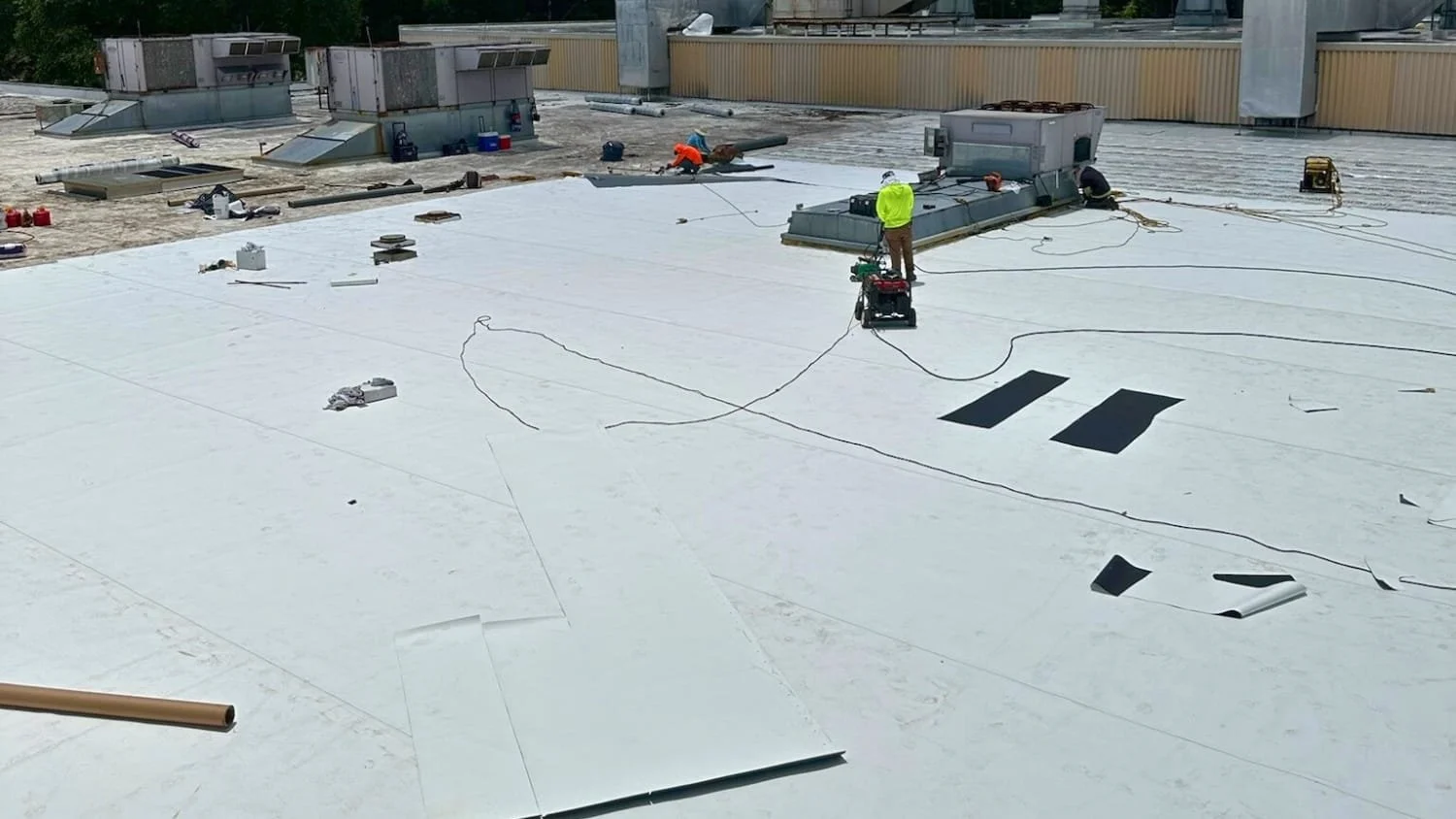
TPO membrane has become the dominant choice for self-storage roofing in the Akron market, and for good reason. The economics of storage facilities run on thin margins: operators compete aggressively on monthly rental rates, and capital expenditures must be justified over long amortization periods. TPO offers a competitive installed cost, excellent reflectivity that reduces summer cooling loads in climate-controlled buildings, and proven durability in northeast Ohio's freeze-thaw cycles. Sixty-mil TPO with fully adhered installation over polyiso insulation is a common specification on Summit County storage projects.
Climate-controlled storage units — the premium tier at facilities like Public Storage — create a roofing insulation requirement that standard unheated storage buildings do not. When interior spaces are maintained at 55°F or above year-round, the thermal performance of the roof assembly directly affects utility costs month after month. Akron winters are long and cold, with average January lows in the mid-teens. A roofing contractor who underspecifies insulation R-value on a climate-controlled building leaves the operator with elevated heating bills for the life of the roof.
Tenant belongings protection during active roofing work is a genuine operational constraint at storage facilities. Akron-area storage operators typically maintain occupancy rates above 90 percent, meaning that at any given time, nearly every unit contains someone's belongings. Roofing crews must work in defined sections, installing temporary waterproofing at the end of each shift, and maintaining watertight conditions between active work zones. Communication with the facility manager about daily work scope is essential so that tenants accessing their units are not surprised by construction activity overhead.
Security lighting and surveillance cameras are integral to storage facility operations — and they penetrate the roof membrane at numerous points. Every camera mount, conduit penetration, and antenna base is a potential leak point if not properly flashed. Experienced commercial roofers in Akron treat each penetration as a custom flashing fabrication task, using manufacturer-approved pipe boots and pressure-sealed collars rather than generic patches. When replacing an aging membrane on an established storage campus, the contractor's first walkthrough inventory should catalog every existing penetration so that none are missed during the new installation.
Multi-building storage campuses also present drainage planning complexity that single-building projects do not. Buildings positioned close together can shed water onto adjacent structures or into the drives between them, creating ice hazards in winter and mosquito-breeding ponding in summer. A commercial roofing contractor designing a campus-wide drainage plan for an Akron storage facility needs to account for the overall site grade, gutter and downspout discharge locations, and the relationship between roof drainage and the property's storm sewer connections.
EPDM remains a viable option on older storage buildings in Akron where the existing deck condition favors a recover rather than a full tear-off. When a steel deck is sound but the original single-ply membrane has reached end of life, a properly installed EPDM recover can extend service life significantly at lower cost than full replacement. The key qualification is a thorough moisture survey of the existing insulation — recovering over wet insulation is a common mistake that accelerates deck deterioration and voids manufacturer warranties.
Self-storage operators in the Akron market increasingly treat the roof as a revenue asset rather than simply a maintenance liability. Rooftop solar installations are gaining traction on storage campuses because the flat, unobstructed roof area is ideal for panel arrays, and the continuous nature of the buildings means a single interconnection can serve the entire campus. Commercial roofers who can coordinate the waterproofing system with solar mounting ballast or penetrations — ensuring warranty integrity on both systems — are increasingly in demand from Summit County storage operators investing in long-term capital improvements.
- How long does it take to reroof a multi-building storage campus in Akron?
- A typical 10–15 building storage campus in Akron takes 3–5 weeks depending on building size, existing conditions, and weather. Contractors work building by building to keep the facility operational throughout.
- What membrane is most cost-effective for Akron self-storage roofs?
- TPO is generally the best value in the Akron market — competitive installed cost, good reflectivity, and proven performance through northeast Ohio freeze-thaw cycles. Sixty-mil fully adhered over polyiso is a common specification.
- Do roofing crews need to notify tenants before working on their building?
- Yes. Best practice is for the facility manager to post notices at affected building access doors 24–48 hours ahead, and for the roofing contractor to coordinate daily work scope with the manager so tenants are not caught off guard.
- What R-value insulation is recommended for climate-controlled storage in Akron?
- Most Akron roofing contractors specify R-25 to R-30 for climate-controlled storage buildings, achieved with polyiso insulation in multiple layers to minimize thermal bridging at fastener locations.
- Can security cameras and lighting be re-mounted after a roof replacement?
- Yes. All penetrations are re-flashed and resealed as part of the roofing scope. The contractor coordinates with the facility's security vendor to ensure cameras are offline only briefly during remounting and that all new penetration flashings are inspected before the vendor reconnects equipment.